
Leverage betting explained: Multipliers, bust price and traps
A multiplier does two things at once, and platforms only advertise one of them.
It multiplies your return, and it divides the distance between your entry and the price at which you lose everything.
At 1000x, that distance is about 0.1%. Bitcoin covers 0.1% in seconds, routinely, for no reason at all.
So the honest way to read a multiplier is as a countdown rather than a payout. Continue reading to understand why!
Multiplier, leverage, same thing
Casinos say multiplier. Exchanges say leverage.
Both mean your position is larger than your stake by that factor. A $10 stake at 100x controls a $1,000 position.
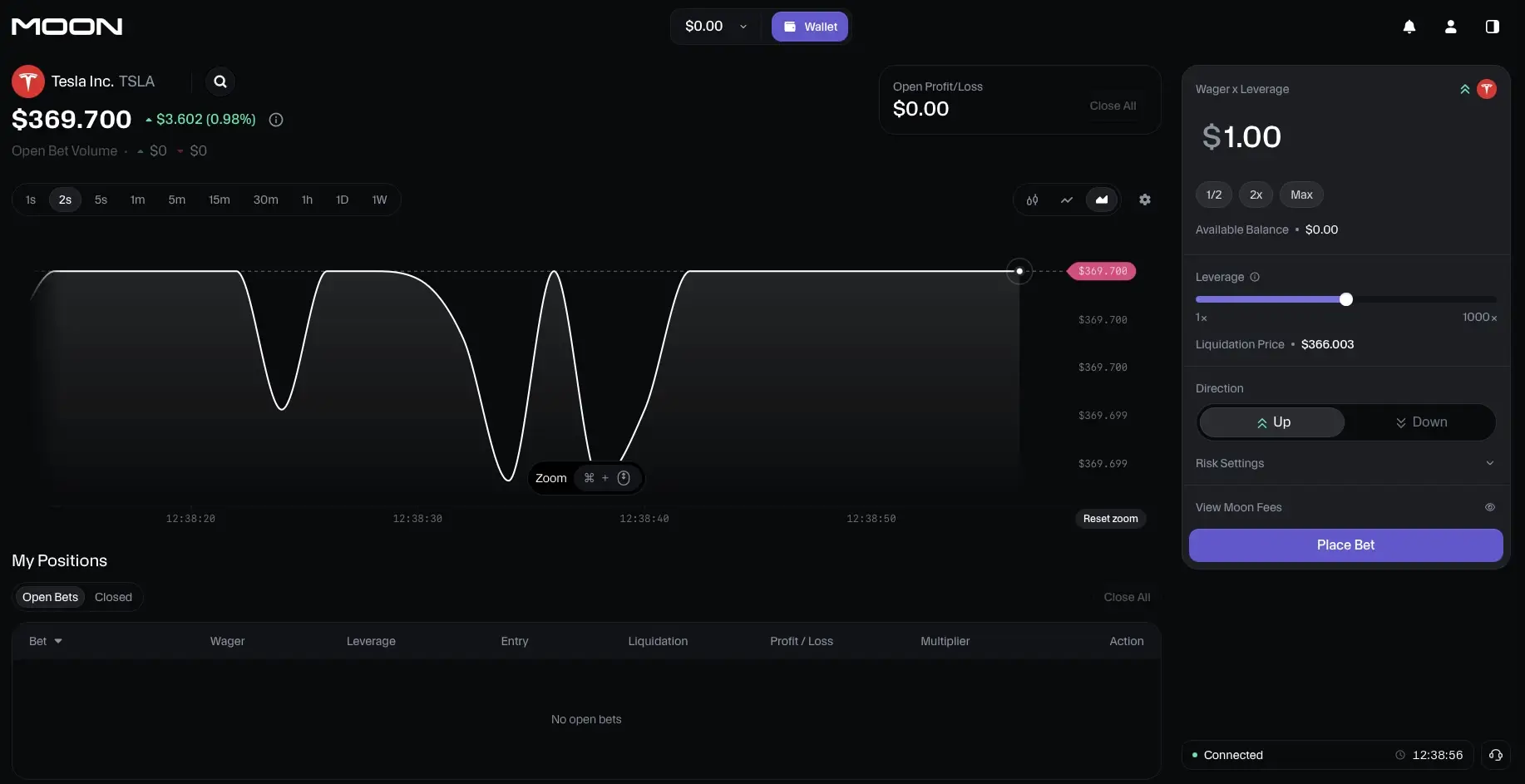
If the price moves 1% in your favour, that $1,000 position gains $10, which doubles your stake. If it moves 1% against you, the $10 is gone.
That symmetry is the whole thing. The multiplier that turns a 1% move into a 100% gain is the same multiplier that turns a 1% move into a total loss.
The bust price, in one table
Your bust price, also called liquidation or liquidation price, is where your stake is exhausted. Ignoring fees, the adverse move needed is roughly 100 divided by the multiplier. Here is what that looks like with Bitcoin at around $75,700.
| Multiplier | Adverse move that busts you | In dollars on BTC near $75,700 | What that size of move is |
| 2x | 50% | About $37,850 | A genuine crash |
| 10x | 10% | About $7,570 | A very bad week |
| 50x | 2% | About $1,514 | A bad day |
| 100x | 1% | About $757 | A normal hour |
| 200x | 0.5% | About $379 | A normal few minutes |
| 500x | 0.2% | About $151 | A normal minute |
| 1000x | 0.1% | About $76 | Often less than one candle |
Read the last column rather than the first.
At 1000x you are not betting on where Bitcoin goes. You are betting that it does not wobble $76 in the wrong direction before it goes where you think, and over any short window that is close to a coin flip with a fee attached.
Fees make it slightly worse than the table suggests, because an opening fee comes out of your stake before the price has moved at all, which brings the bust price marginally closer.
Why a real exchange will not give you 1000x
Mainstream venues cap leverage far below what crypto casinos offer, and that is a deliberate risk decision rather than a lack of ambition.
Polymarket Perps, which runs a real order book, tops out at 20x on majors and publishes its maintenance margin as 0.5 divided by max leverage. At 20x that is 2.5%, so you are liquidated when your equity falls below 2.5% of the position rather than at zero.

The practical difference is enormous.
A 2.5% buffer survives ordinary volatility. A 0.1% buffer does not survive anything. One is a trading product with a risk model, the other is a short-duration bet dressed as one.
The fee question nobody explains
This is the most expensive detail in the category and it is almost never spelled out. When a platform charges a percentage fee, you need to know what it charges the percentage on.
Moon.com charges a 1% opening fee on your wager, not on the leveraged total.
Their own fee calculator makes it concrete: a $1 wager at 100x creates a $100 position, and the fee is $0.01. That is 1% of the wager.
Now imagine the same 1% charged on the position instead. On that $100 position the fee would be $1, which is your entire wager, gone before the trade starts. The same advertised percentage, applied to a different base, differs by exactly the multiplier.
| Fee on wager (Moon model) | Fee on position | |
| Wager | $1 | $1 |
| Multiplier | 100x | 100x |
| Position size | $100 | $100 |
| Advertised fee | 1% | 1% |
| Charged on | The wager | The leveraged position |
| Fee paid | $0.01 | $1.00 |
| Share of your stake | 1% | 100% |
So when you read “1% fee”, find out which base it applies to before you judge whether it is cheap.
Moon’s structure is genuinely one of the cheapest in this category, and it only looks that way once you know what the percentage is measured against.
The other three costs
- A cut of your profit.
Several platforms charge nothing to open and instead take a share of winnings. Rollbit’s own ROI calculator shows the effect: with a 1x multiplier, a 1% price move produces a 0.89% return, a 10% move produces 8.99%, and a 1000% move produces 899.99%. The ratio converges on 0.9, implying roughly 10% of profit is taken on close. Losses are not discounted in the same way, so you lose the full amount and keep about 90% of gains. - Funding or overnight charges.
Positions held open accrue a periodic cost. BetFury charges every 8 hours, roughly 0.03% per day. Rollbit’s own explainer says bets held longer than 8 hours may incur or receive hourly funding depending on market conditions. Polymarket caps funding at plus or minus 4% per hour, which is a very wide band in a one-sided market. None of this matters on a 30 second bet and all of it matters on a position you leave open overnight. - The exit price.
The least visible cost. BetFury closes winning positions at a guaranteed price it sets rather than at the live market. That is disclosed, and it is an edge on every winning trade that never appears in a fee schedule.
Flat fee or profit fee: which to pick
Several platforms, including Rollbit and BetFury, let you choose. The trade is straightforward.
A flat fee is prepaid and you keep all profits. It is better when you expect a large move, because the cost is fixed while the upside is not.
A profit fee costs nothing up front and takes a slice of winnings. It is better when you are uncertain or expect a small move, because a losing trade costs you nothing extra.
Rollbit’s ROI calculator exists specifically to let you compare the two before you commit, and it is worth using.
If a platform offers the choice and gives you no tool to model it, that tells you something about how much they want you to optimise.
What leverage betting does well
Two things, and they are real.
Your loss is capped at your stake.
On a real exchange, a violent gap can leave you owing money. On these products it cannot. Liquidation closes the position and the damage stops at what you put in. For a lot of people that is the difference between a risk they can size and one they cannot.

You can see the bust price before you commit.
On the better platforms, anyway. Moon and Rollbit both display the liquidation price live in the bet panel as you move the multiplier slider, so the trade-off is visible at the moment you make it.
That is good design and it is not universal: Moonlander publishes no liquidation formula or maintenance margin at all, which means you cannot calculate your own bust price, let alone check the one you were given.
How to use a multiplier sensibly
If you are going to do this, a few things measurably improve the experience.
- Pick the multiplier from the move you expect, not the return you want.
If you think Bitcoin moves 0.5% in your direction, anything above about 200x busts you on the way there. Work backwards from the table above. - Treat 500x and 1000x as entertainment rather than strategy.
At that resolution you are paying a fee to flip a coin quickly. - Check the bust price on screen before every bet.
If the platform does not show one, assume the worst and size accordingly. - Use take profit and stop loss where they exist.
BetFury and Moon both offer them. They do not change the edge, but they remove the need to watch a screen and they stop a winning position becoming a losing one. - Keep positions short unless you have priced the funding.
Overnight carry on a leveraged position is a real cost and it compounds quietly.
FAQ
What is a bust price?
The price at which your stake is exhausted and the position closes automatically. Also called the liquidation price. Roughly 100 divided by your multiplier, as a percentage move against you.
What does 1000x leverage actually mean?
Your position is 1000 times your stake, and a 0.1% move against you ends it. On Bitcoin near $75,700 that is about $76.
Can I lose more than my stake?
Not on these platforms. Liquidation closes the position rather than leaving you in debt, which is a genuine advantage over margin trading on a real exchange.
Why do real exchanges cap leverage so much lower?
Because they run a risk model. Polymarket Perps caps at 20x and requires 2.5% maintenance margin, which leaves room for ordinary volatility. A 0.1% buffer leaves none.
Is a 1% fee cheap?
It depends entirely on what it is charged on. Moon charges 1% of your wager, so a $1 wager at 100x costs a cent. The same 1% charged on the leveraged position would cost a dollar, which is the whole wager.
Should I pick the flat fee or the profit fee?
Flat fee if you expect a big move, since the cost is fixed and the upside is not. Profit fee if you are unsure or expect a small move, since a loss costs you nothing extra.
What is funding?
A periodic charge for holding a position open. BetFury charges every 8 hours at roughly 0.03% a day. Polymarket settles on an 8 hour cycle capped at plus or minus 4% per hour. Irrelevant on short bets, significant on long ones.