
Futures trading in crypto casinos: Everything you need to know!
With Bitcoin smashing through its all-time high and Trump doubling down on pro-crypto policies, the market’s going crazy. And so are the casinos.
While crypto futures platforms are popping left and right, I did notice that some crypto casinos also include futures trading.
The question is: is this the next crypto meta? Let’s find out!
🔑 Key Takeaways
- You can now bet on short-term price movements of coins like BTC, ETH, and meme tokens directly at select crypto casinos.
- Crypto casino futures are simplified, gamified versions of futures with no liquidation risk, ideal for fast-paced, high-risk bets.
- Some platforms offer up to 1,250x multipliers, but the higher the reward, the riskier the play.
- On-chain betting, wallet-based staking, and provable fairness are turning futures-style gambling into a fully decentralized experience.
What is casino futures trading?
Casino futures trading lets you bet on whether a crypto price will go up or down over a short period, usually 30 seconds to a few minutes.
Think of it as a stripped-down version of Binance futures, minus the charts and liquidation risk.
You’re not buying or selling real assets. Instead, you’re placing a wager on short-term market movement.
You choose a coin, select “Up” or “Down,” and stake your bet. If the price moves in your predicted direction by the end of the timer, you win.
Some casinos even let you adjust leverage, pick expiration times, or automate your bets. It’s a mix of trading and gambling – quick, risky, but fun when timed right.
How a crypto trading game actually works
Every one of these products or games runs the same four steps, whatever it calls itself.
- Pick a market. Usually BTC, ETH, SOL and a handful of majors. A few platforms go wider. Moon.com covers stocks, forex, commodities and indices alongside crypto, so you can bet on Tesla or gold in exactly the same interface.
- Pick a direction. Up or down, long or short. That is the whole decision. Some products dress it up: BC.Game splits the same idea into four modes called High Low, Up Down, High Low Spread and Tap Trading.
- Set a stake and a multiplier. Your stake is what you risk. The multiplier decides both how fast you win and how little the price has to move against you before you are wiped out. At 1000x, a 0.1% move in the wrong direction ends the position. Bitcoin moves that much in the time it takes to read this paragraph.
- Watch the bust price. Good platforms show you, before you commit, the exact price at which you lose everything. Moon and Rollbit both display it live in the bet panel. Others do not publish the formula at all.
Then you either close the position yourself, hit a take-profit or stop-loss if the platform offers them, or get liquidated. Losses stop at your stake. You cannot end up owing money, which is a genuine and underrated difference from trading on a real exchange.
You are not buying crypto
This is the point most guides skip and it matters more than any fee or bonus.
When you buy Bitcoin on an exchange, you own Bitcoin. You can withdraw it, hold it for years, send it to someone, stake it where applicable, and it is yours regardless of what the exchange does next.
When you place a 100x up bet on Bitcoin at a crypto casino, you own a bet. There is no Bitcoin anywhere in the transaction.
The platform is not buying BTC on your behalf, it is not hedging in any way you can see, and nothing is held in your name.
The practical consequences are worth spelling out for readers. You cannot withdraw the asset, only your balance.
You get no airdrops, no forks, no staking yield and no governance rights. Your position has an expiry in practice even where the product calls itself perpetual, because funding costs and liquidation will eventually end it. And the thing determining your outcome is not the asset but the platform’s reading of the asset’s price.
If what you actually want is exposure to Bitcoin over months or years, a trading game is the wrong tool and will cost you money through fees and liquidations on noise. If what you want is a fast, cheap, capped bet on a short price move, it is a reasonable tool.
Who you are betting against
There are three counterparty models in this category and they are not interchangeable. This is the first thing to check about any platform, and almost nobody publishes it clearly.
| Model | Who takes the other side | Why it matters | Examples |
| House-banked | The casino takes the other side of your bet. It pays your wins out of its own book and keeps your losses. | It profits when you lose. Every rule it sets, from the close price to the liquidation formula, is set by a party with an interest in your outcome. | Rollbit, BetFury, BC.Game, Moon.com |
| Pool-banked | An open liquidity pool takes the other side. Anyone can deposit into the pool and become part of the house. | The same directional conflict exists, but the pool is open to join and its holdings sit on-chain where you can inspect them rather than being a private balance sheet. | Moonlander (MLP pool) |
| Order book | Another trader takes the other side. The venue matches you and charges a fee either way. | No conflict. The venue earns the same whether you win or lose, which is how real exchanges work. | Polymarket Perps |
House-banked is by far the most common and it is not automatically bad.
Every casino game is house-banked and the model is well understood. But it means the operator writes the rules of a game it has money riding on, so the quality of its disclosure becomes the thing you are really judging.
BetFury, for example, closes winning positions at a guaranteed price it sets rather than at the live market price. That is documented, which is to its credit, and it is still an edge in the house’s favour that a reader should know about before depositing.
Where your money sits
Custody is the second question, and it decides what happens when something goes wrong.
Operator-held
You deposit into the casino’s wallet and your balance becomes a number in its database. Rollbit, BetFury, BC.Game, Moon and CoinFutures all work this way.
If the operator is hacked, becomes insolvent or simply decides to close your account, you are an unsecured creditor of an offshore company. MetaWin lost roughly $4M from a hot wallet in November 2024, which is the concrete version of this risk rather than a hypothetical one.
Operator custody also means the operator can attach conditions to your own money. BetFury applies a 10x wagering requirement to futures deposits, so a $100 deposit needs $1,000 of futures wagering before it can be withdrawn. That is disclosed in the terms and it is very easy to miss before you deposit.
Non-custodial
Funds stay in your wallet and in smart contracts you can inspect. Moonlander and Polymarket Perps work this way.
No support team can freeze your withdrawal and no company balance sheet stands between you and your money. In exchange you take on smart contract risk, bridging risk and total responsibility for your own keys.
Moonlander is instructive here: genuinely non-custodial, contracts published for both chains, and no security audit referenced anywhere in its documentation for a protocol holding roughly $19M and offering 1000x.
Neither model is strictly safer. They fail in different ways, and a reader should pick the failure mode they can live with.
Real prices, simulated prices and pure RNG
Not every crypto trading game is driven by the crypto market. Three things get sold under the same label.
Real market data
The platform takes prices from actual exchanges. Rollbit builds a composite index across Binance, Coinbase Pro, Kraken, Huobi and OKEx plus derivative venues, and publishes the full calculation. Moon uses DXFeed, Pyth and SEDA. Moonlander uses Pyth. If the price on your screen matches the price on CoinGecko, you are in this category.
Simulated
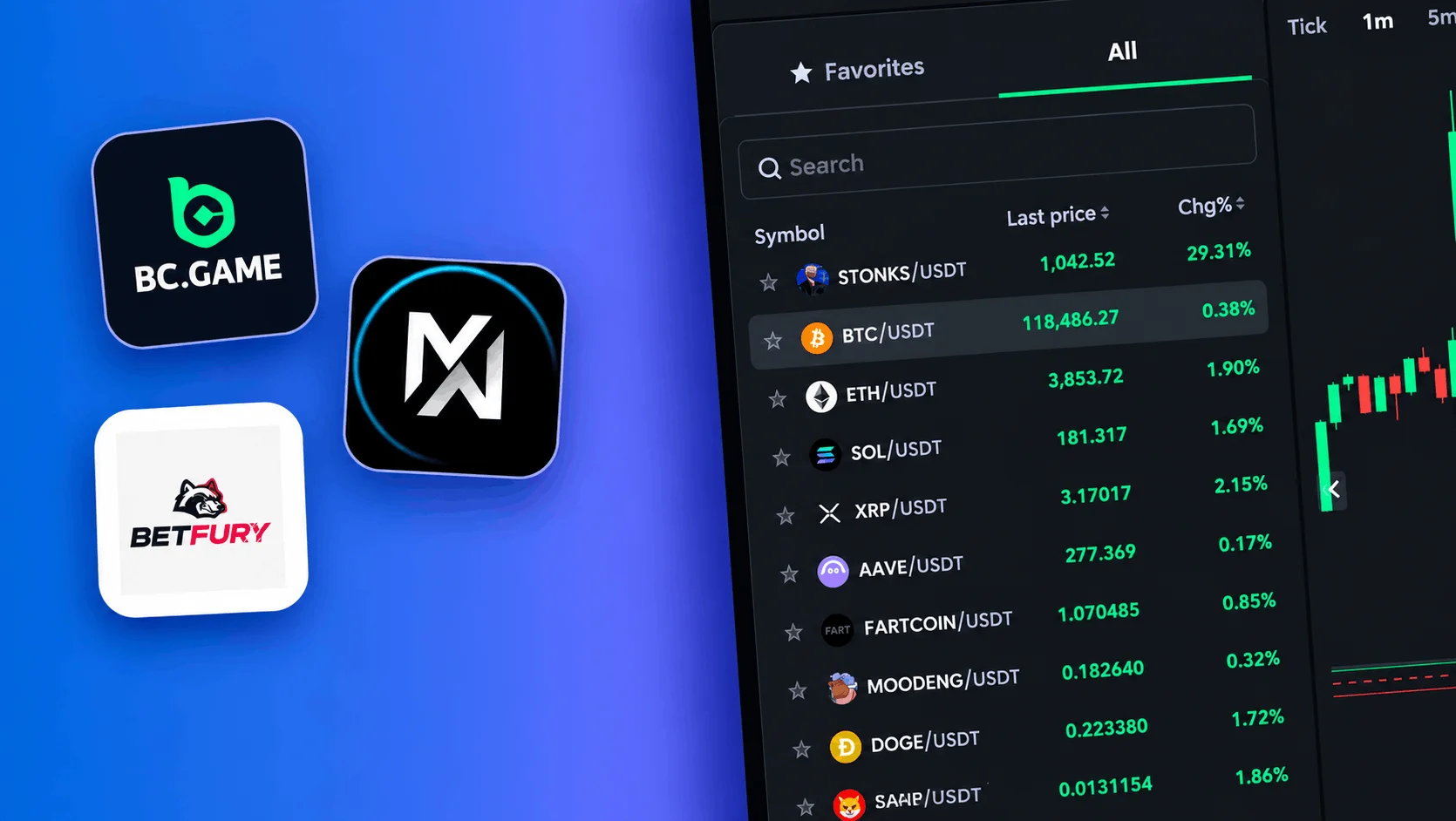
The platform generates a price series designed to behave like crypto. CoinFutures describes its product as powered by a smart algorithm that mimics real crypto volatility. BetFury’s FuryWaves and BC.Game’s STONKS/USD are synthetic instruments sitting alongside the real markets on the same interface. The chart looks identical. It is not the market.
RNG
The outcome is a random number and the platform says so. Evolution’s Stock Market Live is the honest example: a live game show with a fictional market, a 99% RTP and a 1% house edge, openly described as an RNG casino game. Betfury’s Furywave is a more interesting case, where the entire 24 hour price path is pre-drawn from a seed revealed at the end of the round, which makes it provably fair and also means it is not a market at all.
None of these is inherently dishonest. The problem is that a simulated product and a real one look the same in the interface, and most sites reviewing them do not tell you which you are looking at. We flag it on every platform in our database.
Crypto casinos with futures trading




Want something a little different? Moon.com isn’t a casino, but it’s a fun price-betting alternative worth a look. Read our review below.
Best casino futures platforms: Reviewed
Let’s be real, most crypto casinos throw in a chart and call it “trading.” But only a few actually deliver something that feels like a real futures terminal. I’ve tested them all – here’s where you should start if you want to trade prices.
BC.Game
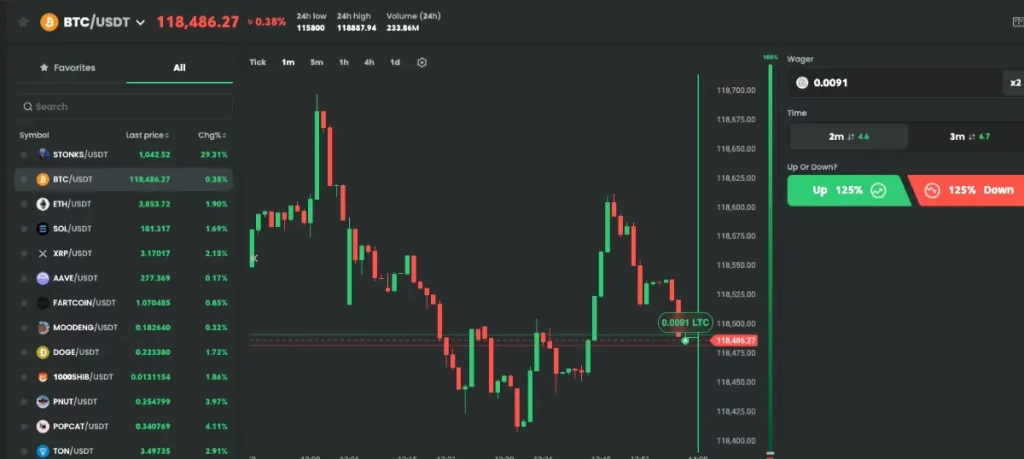
BC.Game’s crypto futures terminal is as fun as it is risky. You can trade BTC, ETH, XRP, and dozens of meme coins at BC.Game – including its own $STONKS, where you can even verify fairness on-chain.
That said, there’s no ½ or quick-reset option, something experienced traders might miss.
Timeframes range from 30 seconds to 5 minutes. And because meme coins are in the mix, you can score massive swings or watch your bet vanish just as fast.
You also have three trading modes:
- High Low Spread
- Up Down
- Futures
Outside the trading pit, BC.Game keeps the action going with 10,000+ games, 60+ Originals (like Crash and Classic Dice), and one of the best welcome bonuses in the industry: up to $220,000 in BCD across 4 deposits.
You can also deposit and withdraw with 130+ cryptos, enjoy up to 99% RTP on BC Originals, and do a lot more.
If meme coin madness and gamified crypto calls sound like your thing, BC.Game is where to start.
BetFury
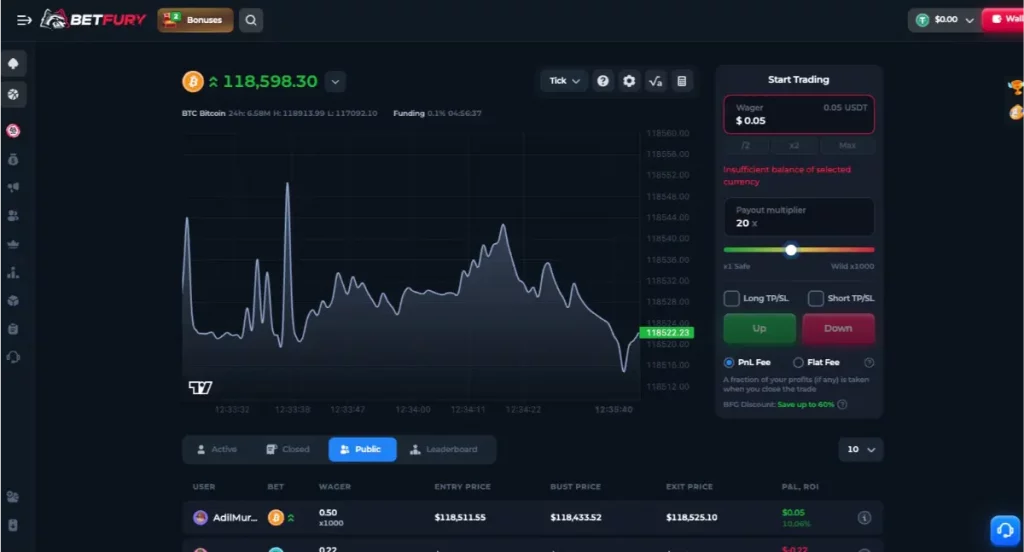
BetFury’s trading terminal is a level up from most casino futures setups. It looks and feels closer to a real exchange: with custom multipliers, TP/SL toggles, manual entry prices, and a real-time leaderboard.
You can toggle between PnL-based and flat fee modes, and if you hold enough $BFG, you’ll unlock up to 60% off trading fees.
That’s a rare perk for casino-native platforms, and BetFury scores high here.
Coin support is solid – BTC, ETH, SOL, XRP, and even underdogs like NOT or CAKE.
But let’s be clear: the terminal is made for players with some trading experience.
Newbies might get overwhelmed fast, especially compared to BC.Game’s one-click simplicity.
As a casino? BetFury’s 8,000+ games, free BTC faucet, and Fury Wheel keep it competitive, but in terms of UX and originality, BC.Game and MetaWin still edge it out.
If you want advanced tools, ROI tracking, and a futures-style trading playground, BetFury’s terminal hits the mark.
Moon.com, the new price-betting site that isn’t a casino
Moon.com launched in August 2026. It’s not a casino, so I’m not ranking it against BC.Game or MetaWin above, but it’s a genuinely fun spin on the same idea and worth a look.
It’s a leveraged price-betting platform built by Easygo, the team behind Stake and Kick. The mechanics sit right between the two columns in the table above: like casino futures, there’s no real asset and no liquidation in the exchange sense; like exchange futures, the markets go beyond crypto, covering stocks, commodities, and forex too, with leverage running up to 1,000x.
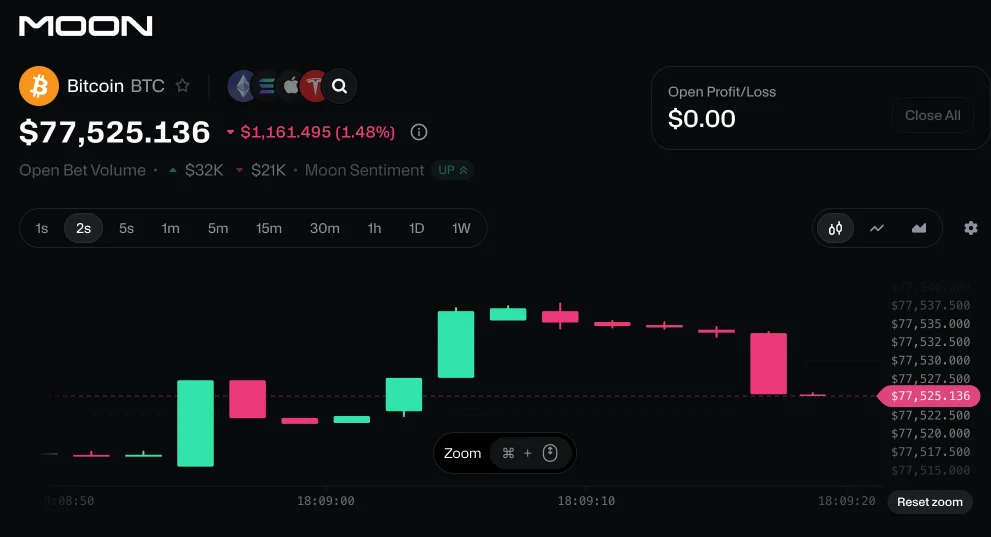
Deposits work with crypto and skip KYC upfront, but withdrawals require it. There’s a $100,000 play-money practice mode if you want to see how the leverage math behaves before staking real funds.
I haven’t tested Moon.com first-hand yet, so treat this as a heads-up rather than a review. I’ll come back and update this once I’ve put real money through it.
Check out Moon.com – use code CBCASH for 3.5% cashback
What are the differences between casino futures vs crypto futures?
Casino futures are gamified and simplified, while crypto futures on exchanges include real assets, complex tools, and serious liquidation risk.
They might look similar at first glance, but they’re not the same.
That is why I’ve created a basic table to show the biggest difference between the two.
| Feature | Casino Futures | Crypto Futures (Exchanges) |
|---|---|---|
| Underlying Asset | Price feed only (synthetic) | Real crypto contracts |
| Leverage | Depends on the platform | Adjustable (up to 150x+) |
| Settlement Time | Instant (30 sec to 5 min) | Flexible (1 min to weeks) |
| Risk of Liquidation | No | Yes, partial or full |
| Interface | Simplified, one-click | Advanced charts, margin tools |
| Regulation | Casino-regulated (or not at all) | Exchange-regulated (in theory) |
| KYC Required | Rarely | Almost always |
Crypto futures, like crypto staking, can be a rabbit hole of their own.
How to trade with crypto futures at casinos?
Trading crypto futures at casinos is way simpler than using an exchange. No order books, no liquidation charts: just pick a coin, call the direction, and place your bet.
Here’s how to get started:
- Sign up at a futures-enabled crypto casino
Pick a crypto casino that supports price-based betting and quick access to terminals. - Deposit USDT or another stablecoin
Most casinos use stablecoins like USDT or USDC for futures bets. Volatile coins like BTC are rarely accepted for this purpose. - Head to the futures or prediction section
Look for “Up & Down,” “Trading,” or “HODL” tabs in the Originals or Web3 section of the site. - Choose a crypto pair
BTC/USDT and ETH/USDT are usually the default options. Some platforms also offer DOGE, XRP, or meme coins. - Pick your direction – Up or Down
Just like futures trading. If you think the price will go up, hit “Up.” If you expect a dump, go with “Down.” - Set your stake amount
Wager a small amount (e.g., $5 USDT) or go bigger. Most platforms let you choose the risk and potential payout. - Confirm your bet and watch the chart
You’ll see a timer or live price feed. If the price ends up where you predicted when the timer runs out, you win. - Claim your profit or repeat the process
If you hit the right call, winnings are paid instantly. If not, you can tweak your strategy and try again.
Final words
I’ve seen a lot of gimmicks in the industry but crypto futures betting? It’s one of the few that actually makes sense.
It’s fast, fun, and hits that dopamine without having to chart candle wicks all day.
Sure, you won’t get the depth of a full-on exchange, but if you want to test your market instincts and maybe turn $5 into $50 in 30 seconds? This is it.
As long as you treat it like betting (not actual trading), crypto casino futures are here to stay.