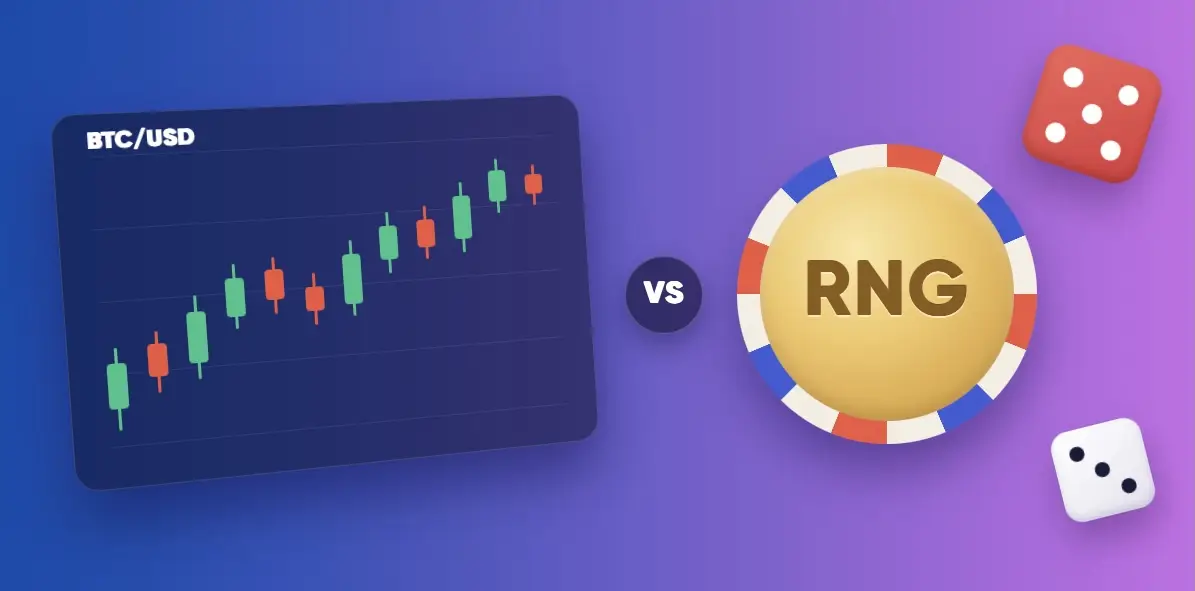

Real market data vs RNG trading games: What are you betting on
Three different things get sold as crypto trading games, and they look identical on screen.
Some take prices from real exchanges. Some generate a price series designed to behave like crypto. Some are a random number generator with a chart drawn on top.
Attention!
All three show you a candlestick chart, a price that ticks, and an up or down button.
The honest headline, which most guides get wrong: a real price feed does not make a product fair, and an RNG does not make it a scam.
Here’s everything you need to know.
The three types
Real market data
The platform pulls prices from actual exchanges, usually through an index or an oracle. The number on your screen matches the number on CoinGecko. Rollbit, Moon.com, BetFury, Moonlander and Polymarket Perps all work this way.
Simulated
The platform generates its own price series, built to move like crypto without being crypto. CoinFutures describes its product as powered by a smart algorithm that mimics real crypto volatility. The chart behaves plausibly. It is not connected to any market.
RNG
The outcome is a random draw and the platform says so. Evolution’s Stock Market Live is the clean example: a live game show built around a fictional market, with a published 99% RTP and a 1% house edge.
There is a fourth thing worth knowing about, because it sits inside otherwise real platforms.
Several operators run a synthetic market alongside their real ones, on the same interface, with the same buttons.

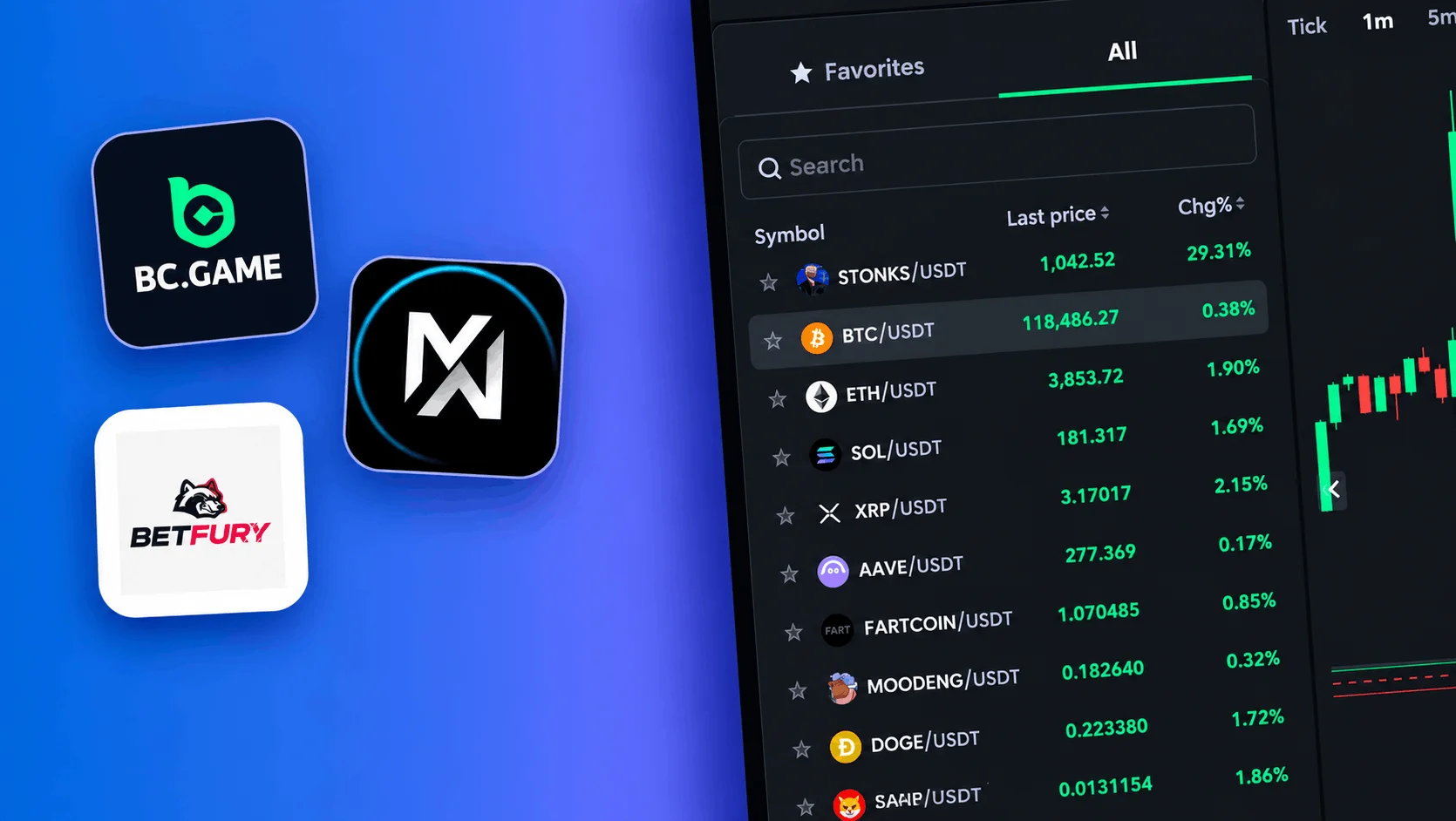
BetFury has FURYWAVES. BC.Game trades a pair called STONKS/USD next to its real crypto markets. Neither is hidden exactly, but neither is flagged in a way a new player would notice.
What each platform actually uses
| Platform | Feed type | Source | Can you verify it? |
| Rollbit Futures | Real | Composite index across Binance, Coinbase Pro, Kraken, Huobi and OKEx, plus coin and USDT margined derivative venues | Yes. Rollbit publishes the constituent exchanges and the full calculation method |
| Moon.com | Real | DXFeed, Pyth and SEDA | Partly. The providers are named, the methodology is not published in detail |
| Moonlander | Real | Pyth plus Cronos Oracles | Yes for the feed. Pyth prices are on-chain and checkable |
| Polymarket Perps | Real | Mark price tracking multiple external venues, premium index sampled every 5 seconds and averaged hourly | Yes. The index and funding mechanics are documented |
| BetFury Futures | Real, plus a synthetic mode | Average weighted price across the largest markets. FURYWAVES is an in-house synthetic market | Partly. The anti-manipulation design is described, the venue list is not |
| BC.Game Crypto Futures | Real, plus a synthetic market | Real crypto via the Detrade engine. STONKS/USD is synthetic | Partly. The engine is third-party, the index is not published |
| CoinFutures | Simulated | An in-house algorithm that mimics crypto volatility. No exchange connection | No. There is nothing external to check it against |
| Stock Market Live | RNG | Evolution RNG, fictional market, 99% RTP and a 1% edge | No seed to check, but lab certified and openly declared |
How to tell which one you are looking at
You do not need the documentation to work this out. Three checks, each under a minute.
Compare the price to a real source
Open CoinGecko or your exchange of choice next to the platform. If BTC reads 75,710 on one and 1,249 on the other, you are not looking at Bitcoin. This sounds obvious and it catches most synthetic markets immediately, because they usually trade at a completely different price level.
Read the instrument name
Real markets are named BTC/USD or BTCUSDT. Synthetic ones tend to have invented names: STONKS/USD, FURYWAVES. If you cannot find the ticker on a real exchange, it does not exist on one.

Look for the words
Platforms are often more honest in their own documentation than in their marketing.
BetFury’s own page describes its product as a tool for simulating futures trading. CoinFutures says its algorithm mimics real crypto volatility. Stake’s game information table lists Stock Market Live’s game type as RNG Casino Game.
None of that appears on the trading screen, and all of it is one click away.
Why a real feed matters less than you think
This is where most coverage of this topic goes wrong.
People treat a real feed as proof the product is fair. It is not, for a simple reason: the feed decides what happened, but the platform decides what that is worth to you.
On a house-banked product, the operator still controls the fee you pay to open, the fee you pay on profit, the funding charged while the position is open, the price at which you get liquidated, and in at least one case the price at which a winning position closes.
BetFury documents that winning trades close at a guaranteed price it sets rather than at the live market.
The feed can be immaculate and the economics can still run against you.
The reverse is also true.
Stock Market Live is pure RNG with no real market anywhere in it, and it returns a published 99% with a 1% house edge charged transparently as a commission when you cash out.
In expected value terms that is better than almost every real-feed product in this category, because those charge opening fees, profit cuts and funding on top of a spread you cannot see. The RNG game is the honest one.
Provably fair is not the same as a real feed
These two ideas get mixed up constantly, so it is worth separating them.
Provably fair means the outcome was committed to in advance and you can check afterwards that nobody changed it.
The platform publishes a hashed seed before the round, reveals the seed after, and you verify that the result matches. It proves the operator did not tamper with the result once it saw your bet.
A real feed means the price came from actual markets rather than from the operator.
Whether that is better or worse than a real feed depends on what worries you. If you are worried about the house moving the price against your position, provably fair RNG removes that risk completely and a real feed only reduces it.
If you wanted actual exposure to Bitcoin’s direction, provably fair RNG gives you none.
One more distinction.
Lab certified is not provably fair. Evolution’s games are tested and certified by independent labs, which is a real and meaningful control, but you cannot personally verify any individual round.
You are trusting the certification rather than checking the maths.
When simulated feeds are a genuine problem
Simulation is not inherently dishonest. The problem is presentation, and it shows up in three specific ways.
The product is marketed on real-world assets it does not use.
If the landing page talks about Bitcoin, Ethereum and Solana, and the engine behind it is generating its own prices, the reader has been told something untrue by implication even if no single sentence is false.
The synthetic market sits next to the real ones.
A player who has learned to trade BTC on a platform and then clicks into FURYWAVES or STONKS/USD is in a different kind of product with the same controls, the same chart style and no warning.

There is nothing external to check against.
With a real feed, a dispute about where the price went can be settled by looking at another exchange. With a simulated feed and no published seed, there is no independent record at all. You have the platform’s word and nothing else.
What to actually check before you deposit
- Does the platform say, in its own documentation, whether the feed is real, simulated or RNG?
- If real, does it name the exchanges or the oracle? Rollbit naming its index constituents is the standard to measure others against.
- If RNG, is it provably fair with a published seed, or certified by a lab you can look up?
- Does the price on the screen match a real source right now?
- Are there synthetic markets mixed in with the real ones, and are they labelled?
- Separately from all of the above, what does a trade cost and who closes your position?
That last one is the point of this whole article.
Feed authenticity is one axis. Player economics is another.
A product can score well on one and badly on the other, and most of this category does exactly that. Every platform in our database is labelled on both.
FAQ
Are crypto trading games using real Bitcoin prices?
Some are. Rollbit, Moon, BetFury, Moonlander and Polymarket Perps take prices from real exchanges or oracles. CoinFutures runs a simulation. Stock Market Live uses random generation. BetFury and BC.Game each run a synthetic market alongside their real ones.
Is an RNG trading game a scam?
Not if it says so. Stock Market Live is RNG, publishes a 99% RTP and a 1% edge, and is lab certified. That is a more honest product than a real-feed platform that will not publish its fees. The problem is RNG or simulation presented as if it were a market.
What is provably fair in a trading game?
The platform commits to the price path before the round via a hashed seed, then reveals the seed so you can verify nothing was changed.
Can I check the price myself?
Yes, and you should. Open the platform next to CoinGecko. If the numbers do not line up, you are not trading the asset you think you are.
What are FURYWAVES and STONKS/USD?
In-house synthetic markets at BetFury and BC.Game. They sit in the same interface as the real markets and are not connected to any exchange.
Does a real price feed mean the game is fair?
No. The feed determines what happened. The operator still sets the fees, the funding, the liquidation level and sometimes the price your winning trade closes at. Check both.