
Can you trust original casino games?
Most online casinos now carry in-house games alongside the usual slots and live tables: Crash, Plinko, Mines, and Dice.
They load fast, the rules are simple, and the RTPs often look competitive.
The question worth asking before you play: who’s actually vouching for any of this?
Original games are built and operated directly by the casino – no third-party game developer involved.
That means no external studio checking the math, no independent audit trail by default, and no separate licence backing the game up.
🔑 Key Takeaways
- Original games are built and run by the casino itself, with no third-party developer and no external audit trail by default
- Provably fair technology is the main way players can verify outcomes aren’t manipulated
- Provably fair proves randomness, not good odds. You still need to check the RTP separately
- Licensing doesn’t always cover a casino’s in-house games the same way it covers third-party titles
- Established, licensed platforms are lower risk; anonymous or unlicensed ones are a different conversation
The conflict of interest nobody talks about
With a slot from NetEnt or Pragmatic Play, there’s a chain of accountability.
The developer has its own licence, its own audit history, its own business to protect. The casino just distributes the game.
If something’s wrong with it, the developer answers for it.
With original games, that chain doesn’t exist. The casino builds the game, runs the game, and keeps the profits.
If they nudged the odds, the only people who’d know are the ones who did it.
That’s not a conspiracy claim. It’s just the structure of the arrangement, and it’s worth being clear about before you put money in.
This is exactly why provably fair technology matters so much in this specific context.
What provably fair actually means
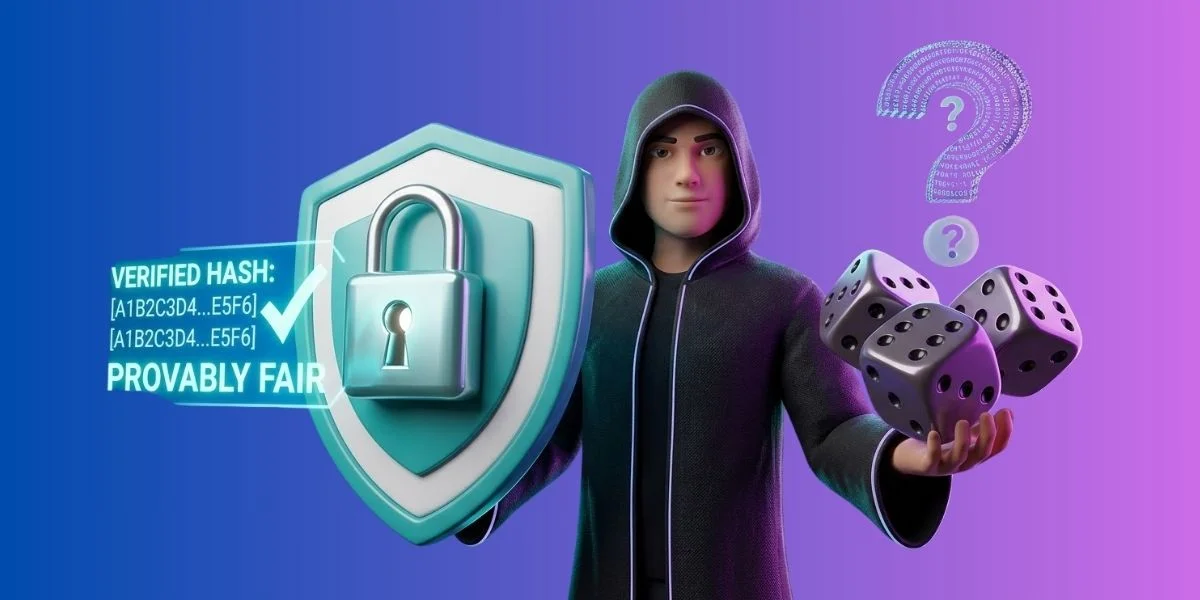
Provably fair is a cryptographic verification system.
Before a round starts, the casino generates an encrypted server seed and gives you a client seed.
After the round, both are revealed, and you can combine them to confirm the result wasn’t altered after the fact.
| Element | What it is | Who controls it |
|---|---|---|
| Server seed | Encrypted value generated before the round | Casino (committed in advance) |
| Client seed | Value you provide or can modify | Player |
| Nonce | Round counter | Shared |
| Combined hash | Verifiable outcome | Neither, it’s math |
It came out of Bitcoin gambling around 2013–2015, when there was no regulation, and the only available trust mechanism was the math itself.
Today, provable fairness is standard on most platforms running original games.
If a casino offers originals without any provably fair system, that’s a red flag.
Provably fair doesn’t mean fair odds
This is where people get it wrong.
Provably fair tells you the result was random.
It says nothing about whether the odds are any good.
A game can be completely verifiable and still pay back 85 cents on the dollar. Randomness and fairness aren’t the same thing. You need both:
- Provably fair system proves outcomes aren’t manipulated
- Published RTP tells you what the return actually looks like over time
Neither one alone is enough.
A casino that advertises “provably fair” without publishing RTPs is answering half the question.
A provably fair system without published RTPs only answers half the question.
You need both to know what you’re actually playing.
Does your licence actually cover in-house games?
This varies more than most players realise, and casinos rarely volunteer the information.
| Regulator | Covers in-house games? | Notes |
|---|---|---|
| UKGC | Yes | All games on platform must meet standards |
| MGA | Generally yes | Some flexibility on implementation |
| Curaçao | Often unclear | Minimal oversight in practice |
| Unlicensed | No | No protection whatsoever |
A casino can hold a legitimate licence for its third-party titles while its original games sit in a regulatory grey zone. It’s not always the case, but it happens, and it’s rarely disclosed upfront.
Worth checking before you assume you’re covered.
Signs a game can be trusted
- Provably fair system that’s actually usable: seed hashes you can verify round by round, not just mentioned in an FAQ
- Specific RTP figures published, not vague language like “competitive returns”
- Clear explanation of rules and house edge before you play
- Independent third-party audit of the originals (rarer, but it exists)
- Platform has been operating for several years with a documented track record
Red flags
- No provably fair system at all, especially on a crypto-focused platform where there’s no excuse
- Missing or vague RTP information
- No access to your own game history or past round outcomes
- Casino licensed in a jurisdiction that does minimal actual oversight
- Game mechanics that are needlessly complicated in ways that obscure the house edge
Does platform size matter?
To a point, yes. An established casino has spent years building a brand.
Rigging their original games would be a reputational disaster that no short-term margin justifies.
With a large player base, statistical anomalies get noticed. The incentive to cheat is structurally lower.
Smaller, newer, or unlicensed platforms are a different conversation.
Less history, less accountability, and in some cases genuinely less to lose.
That doesn’t make every new platform untrustworthy, but it shifts the burden of proof onto you rather than the platform.
| Platform type | Risk level | What to rely on |
|---|---|---|
| Large, licensed, established | Lower | Reputation + provably fair + RTP |
| Small but licensed | Medium | Provably fair + RTP + check reviews |
| Unlicensed, any size | Higher | Provably fair at minimum, proceed carefully |
| Anonymous, no PF system | Avoid | Nothing to rely on |
Final words
Original casino games aren’t inherently untrustworthy. But the usual safety nets aren’t there: no independent developer, no external audit by default, sometimes no clear regulatory coverage.
When provably fair is implemented properly and paired with transparent RTP figures, it genuinely gives players a way to verify what’s happening.
The problem is platforms that use the language of trust without the substance behind it.
Check for a provably fair system. Find the RTP. Look at how long the platform has been running and whether anyone’s had problems getting paid.
None of that takes long, and it tells you most of what you need to know.