

Crypto dice strategies: What actually works (and what people sell you)
Crypto dice looks too plain to have a strategy. You drag a slider, pick a number, and bet on whether the roll lands over or under it. That is the whole game.
So of course it has spawned an entire economy of “strategies,” from free forum systems to scripts people sell for real money, most of them aimed at the biggest name in the category: Stake dice.
This guide covers the crypto dice strategies that actually circulate, how each one works, and whether any of them do what they promise.
🔑 Key takeaways
- Almost every crypto dice game runs a house edge of about 1%, baked into the payout math. No betting pattern removes it.
- The “custom” systems sold for Stake dice and other sites are just Martingale, Paroli, D’Alembert or Fibonacci with new names.
- Strategies sell a feeling, not an edge. A high short-term win rate is real, and it is also the setup for the losing streak that erases everything.
- Provably fair means the site cannot rig a specific roll. It does not mean the game is beatable or predictable.
- The clearest sign a strategy does not work: someone is selling it instead of quietly using it.
What is crypto dice?
Crypto dice is the original in-house dice game you will find on sites like Stake, BC.Game, Duckdice, Bitsler and more. It is not a slot and not a licensed table game.
It is a single random number and a bet on which side of a line it lands.
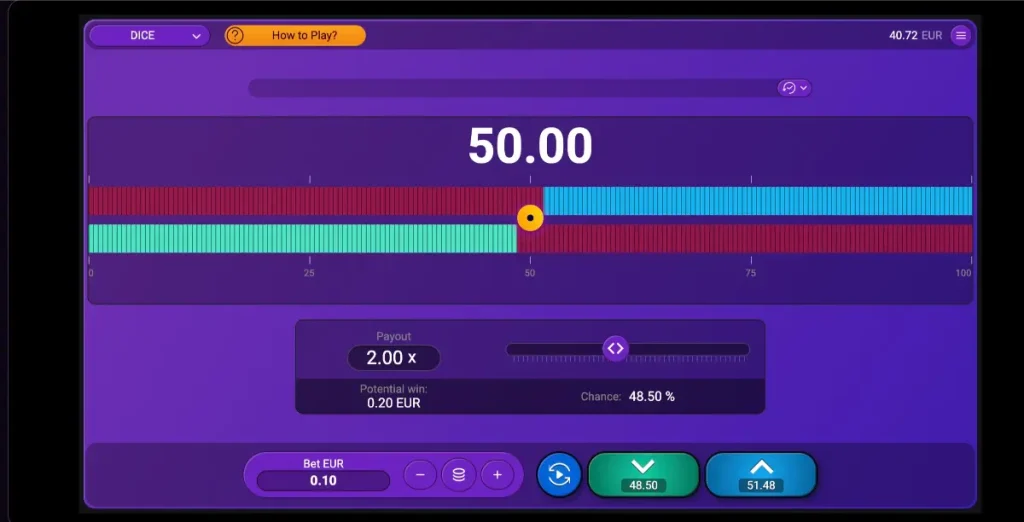
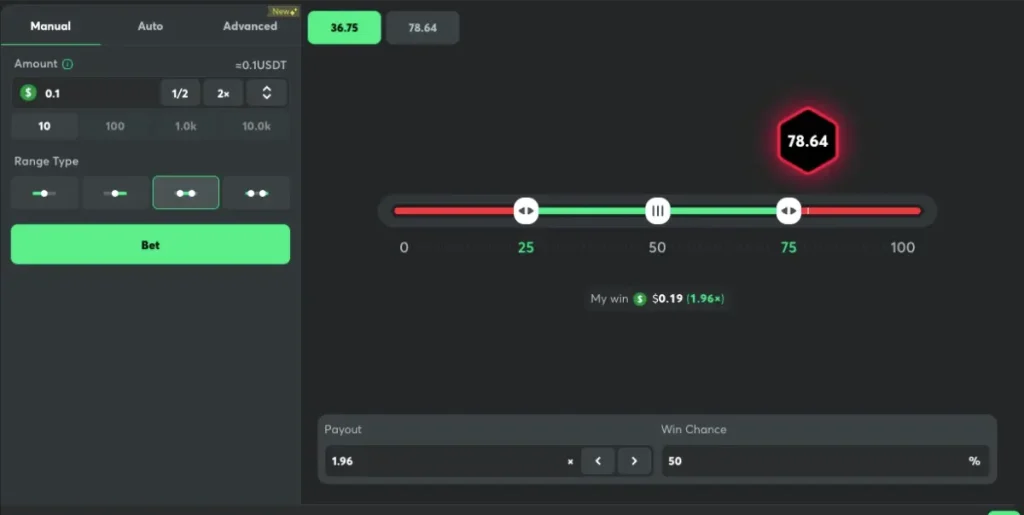
A round works like this: a virtual die returns a number, usually from 0 to 99.99. You set a target with a slider and choose roll over or roll under. Set the target low and roll over and you win most of the time for a tiny payout. Set it high and roll over and you rarely win, but the payout is large.
The one number that runs the whole game
Win chance and payout are two views of the same thing, tied together by a fixed formula:
Multiplier = (100 – house edge) ÷ win chance
Most crypto dice sites use a house edge of around 1%, so the formula becomes 99 divided by your win chance.
Stake dice does exactly this. That “99 instead of 100” is the entire trick. A truly fair game would divide by 100, because a bet you win half the time should pay 2x. Dividing by 99 quietly skims 1% off every bet you make.
The important part: this holds at every setting. A 98% win chance and a 2% win chance carry the same 1% edge. The return to player is 99% across the board.
So almost every crypto dice strategy is really one decision: where to sit on the slider, and how to size your next bet. Neither of those touches the 99. You can make wins frequent and small or rare and huge. You cannot make the average bet profitable.
Tiers of crypto dice “strategy”
Before anyone charges you for a system, it helps to see the ladder.
- At the bottom are the free presets built into the auto-bet panel, which every serious crypto dice site ships.
- In the middle are named community systems shared on forums and dice-bot sites, with proprietary sounding labels that turn out to be small tweaks on the presets.
- At the top are the paid products, sold as secret tested edges: gated configs, premium scripts, and hands-off “sleep” methods.
The truth
The uncomfortable throughline is that the top tier is mostly the bottom tier in nicer packaging.
Nearly every strategy that gets sold is a Martingale, reverse Martingale, D’Alembert or Fibonacci variant with extra conditions bolted on to make the results look smoother than they are.
Crypto dice strategies, explained
Here are the systems that actually get used, grouped by what they are trying to do. We’ve discussed most of them in our exploration of crash gambling strategies.
The classic progression systems
These are the public canon. They are free, they are everywhere, and they are the raw material for everything sold later.
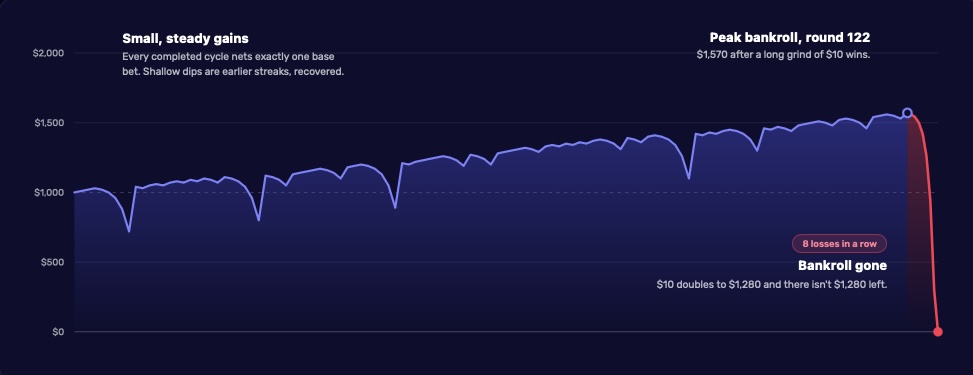
- Martingale. Double your bet after every loss, reset to base after a win. Each win recovers all prior losses plus one unit. It feels bulletproof right up until a losing streak outruns your bankroll. More on that below.
- Reverse Martingale (Paroli). Double after each win instead, and reset after a loss or after a set number of wins. You are riding streaks with “house money.” It caps your losses on cold runs but needs a streak to pay off, and streaks are rarer than they feel.
- D’Alembert. Raise your bet by one unit after a loss, lower it by one after a win. Gentler than Martingale, same direction of travel. Slower bleed, not a fix.
- Fibonacci. Size bets along the Fibonacci sequence (1, 1, 2, 3, 5, 8…), stepping forward on a loss and back on a win. A softer recovery curve than doubling, but it still compounds fast once a streak runs long.
- Labouchere. Write down a sequence of numbers, bet the sum of the ends, cross them off on a win, add your loss to the end on a loss. Fiddly, satisfying to run, and still governed by the same 1% edge as everything else.
The systems sold for Stake dice
This is where the money changes hands. These are the “custom” systems marketed specifically around Stake Dice, usually as auto-bet configs or bot scripts. Read closely, they are all progressions.
- x77700. An aggressive Paroli. It targets roughly a 10% win chance (a 9.9x payout) and increases the bet 500% on every win, aiming to hit a profit target in about six straight wins from a tiny base. Six wins in a row at 10% each is roughly a one in a million event, which is the catch behind the shiny target number.
- Advanced Martingale. The elaborate one, usually credited to a forum user called Tacitusz. It starts at a 50% win chance and, as losses stack, ramps both the win chance (up toward 90%) and the stake (by 300% to 1200%), flipping between over and under along the way. Its own instructions tell you to keep around 300,000 bets in reserve, which tells you everything about how deep the hole can get.
- FPP. A hybrid of flat betting, parlays and step-ups keyed to losing streaks (for example +100% after three losses, +300% on the first three-loss streak, reset on any win). It feels controlled because the dangerous escalation only triggers on the streaks it cannot survive.
- Winning Climb and the “Elmo” script packs. These live in dice bots. Winning Climb is a slow 66% win-chance grind that nudges the stake up on both wins and losses and resets on a small profit target. The “Elmo” packs are named Lua scripts (Double Martingale, Russian Roulette, Lazy Susan, and an “8.91% Win Strategy”). The honest ones ship with a disclaimer that reads, roughly, “works most of the time, but not all of the time, this is gambling.”
- The “sleep strategy“. The archetype of the paid product. A high-win-chance progression built to recover losses through the occasional bigger hit, marketed for running hands-off overnight. It typically survives about five losses in a row and gets wiped out by the sixth.
Bots and scripts
The most technical products are written for external tools like Seuntjie’s DiceBot and MyDiceBot, which connect to Stake and other sites and run full programs.
DiceBot’s programmer mode lets you write a short Lua function that runs after every bet, reading your balance and results and setting the next stake and win chance. It even ships a simulator.
That simulator is exactly why scripts look convincing.
A seller can show you a script climbing smoothly over 100,000 simulated bets. The demo is real but cherry-picked. Because every bet still averages a 1% loss, more bets guarantee the curve eventually turns down. A backtest that never loses is just one that stopped before the streak that breaks it.
Why no crypto dice strategy beats the house
Strip away the names and every system here hits the same three walls.
It is fixed negative expectation
A betting system is only a rule for choosing bet size and timing. It cannot change the odds of any single roll, and on crypto dice those odds are minus 1% at every setting.
A run of negative bets has a negative expected value, full stop.
There is no order of losing bets that adds up to a win.
Gambler’s ruin
Progression systems win small amounts often and lose big amounts rarely.
The rare loss is sized to cancel every small win plus your bankroll. At a plain 2x setting, a Martingale looks like this:
| Losing streak | Chance per attempt | Staked to keep doubling | Reward for surviving |
|---|---|---|---|
| 5 in a row | ~3.3% (1 in 30) | 31 units, next bet 32 | +1 unit |
| 6 in a row | ~1.7% (1 in 60) | 63 units, next bet 64 | +1 unit |
| 7 in a row | ~0.84% (1 in 119) | 127 units, next bet 128 | +1 unit |
| 8 in a row | ~0.42% (1 in 236) | 255 units, next bet 256 | +1 unit |
| 10 in a row | ~0.11% (1 in 927) | 1,023 units, next bet 1,024 | +1 unit |
You risk 1,023 units to make one.
Rare is not never, and auto-bet fires thousands of rolls an hour, so a bankroll-clearing streak is a question of when, not if. High-win-chance “sleep” scripts just move the wall closer: at a 66% win chance the fatal run is five or six losses, which still turns up inside a session.
Site max-bet and balance limits also cap the doubling long before an imaginary infinite bankroll could save you.
The grind tax
Flat and low-volatility systems do not blow up. They bleed.
Because every unit wagered returns 99 cents in expectation, your expected loss scales directly with turnover.
Wager 10,000 units and you should expect to lose about 100. Wager a million and you should expect to lose about 10,000. A “safe” script left running overnight can turn over hundreds of thousands of units while you sleep.
The 1% house edge is quiet, but it never stops, and it is the casino’s actual business model, not the jackpots.
How to actually play crypto dice
If you are going to play, play like someone who understands the math rather than someone buying a way around it.
Pick a low house edge. Since the edge is the only thing that reliably drains your bankroll, a site at 1% or lower matters more than any strategy. Compare the numbers before you deposit, not after. If you want a shortlist, our best crypto dice sites roundup ranks them by exactly this.
Verify provable fairness of a game yourself once, so you stop wondering whether losses are “rigged.” They are not. It is variance, and our provably fair guide walks through checking a seed in a couple of minutes.
Set a bankroll and a stop-loss before the first bet, and treat any strategy as a way to shape entertainment, not to generate income. Martingale gives you a spiky ride with a small chance of a big loss. Flat betting gives you a slow, steady one. Neither is a plan to make money.
Ignore anyone selling certainty. If a system genuinely printed money against a 1% edge, the rational move would be to run it quietly, not to sell it to strangers for a flat fee.
If you want to see this play out without risking anything, our crash gambling strategy tester lets you run systems against the same kind of math and watch the equity curve do what the tables above predict.
Conclusion
Here’s the deal with crypto dice: every bet gives the house about 1%, and no strategy touches that. The systems people sell are real, they just don’t win. They only change how you lose.
So pick your ride. Martingale means lots of small wins and the odd wipeout. Flat betting means a slow bleed. Either way, play on a provably fair site, set a stop-loss, and treat any profit as luck. Do that and crypto dice stays what it should be: fun you can afford.
FAQ
Do crypto dice strategies actually work?
There is no profitable one. If you mean lowest risk of a sudden wipeout, flat betting at a high win chance is the calmest. Progression systems like Martingale feel best in the short term and carry the biggest blow-up risk. Pick based on the ride you want, not on expected profit.
What is the house edge on crypto dice?
Usually around 1%. Stake dice sits at exactly 1%, which is why its payout formula is 99 divided by your win chance. Some sites go a little lower, a few go higher. Lower is always better for the player, since the edge is what drains your bankroll over time.
Is the Martingale strategy good for bitcoin dice?
It is popular because it wins small amounts very often, which feels like success. The problem is the rare losing streak, which is sized to erase every prior win plus your balance. At a 2x setting you can be risking over 1,000 units to win one. It is exciting, not profitable.
Is crypto dice rigged?
On provably fair sites, no. You can verify each result was generated from preset seeds and not altered for your bet. Long losing streaks are normal variance, not manipulation. What is not in your favor is the built-in house edge, which is disclosed, not hidden.
Can you make money with crypto dice?
Individual players get lucky and walk away up. Over enough bets, the 1% or higher edge makes the average result a loss, and no strategy changes that average. Treat any winnings as luck, set a stop-loss, and never bet money you are not prepared to lose.