












































Our Review
Every crash game promises adrenaline. Few actually deliver a fun time.
Crash by Gamdom Originals walks into the room with one very loud claim and then sits quietly in the corner. On paper, it looks like a dream for grinders – Gamdom has done a whole plethora of Originals.
In practice, it feels like the most stripped-down interpretation of crash gambling you can imagine. Here’s why.
Game information
- 1
- 2
- 3
- 4
- 5
Gameplay experience
Crash by Gamdom Originals is exactly what the name suggests.
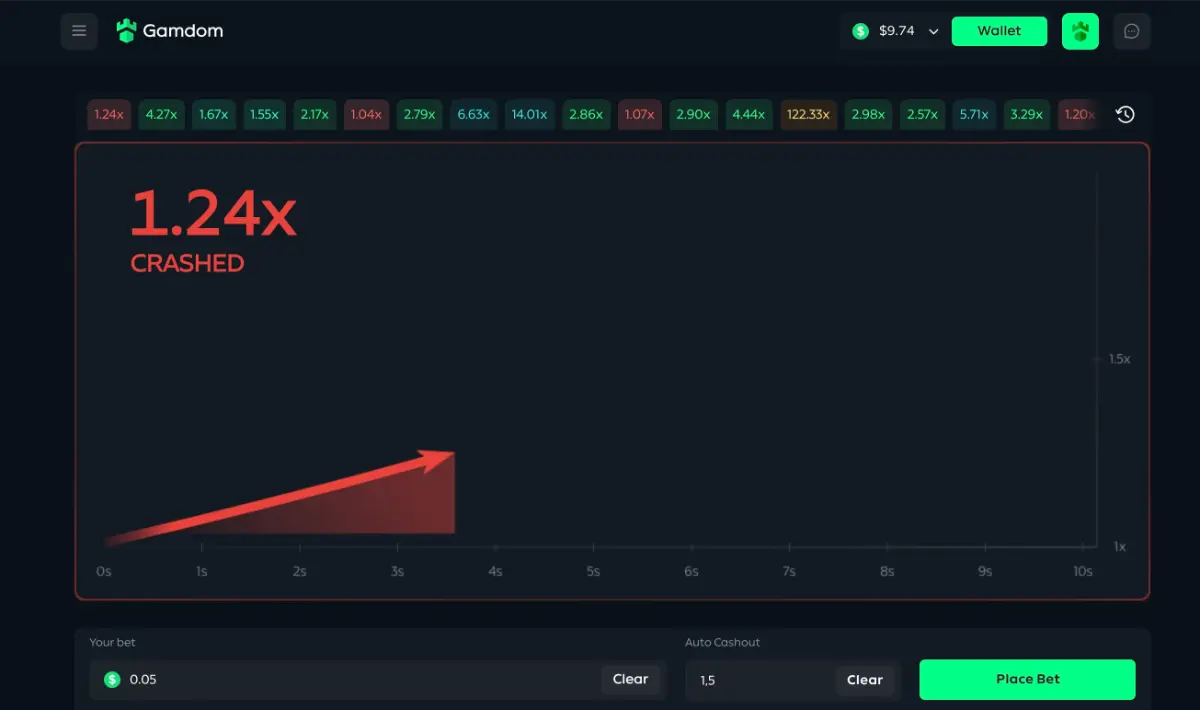
A multiplier rises, you cash out before it crashes, or you lose your bet.
There are no distractions, no side games, no narrative layers. It is a crash in its purest form.
The biggest talking point is the RTP claim.
Gamdom advertises this game as having a near-perfect RTP, which immediately places it in rare territory.
Even the best-known crash originals rarely climb above 99 percent.
Elite company
If that number holds true long term, this is one of the fairest crash games ever released (along with Duel’s 100% RTP).
Unfortunately, everything else about the game feels barebones.
There are no special animations, no dramatic explosions, and no visual cues that build excitement as the multiplier climbs.
The game runs smoothly, but it also feels emotionally flat.
Desktop experience
On desktop, the interface is clean but almost aggressively simple. The multiplier curve sits front and center, the betting panel sits below or beside it, and that is it.
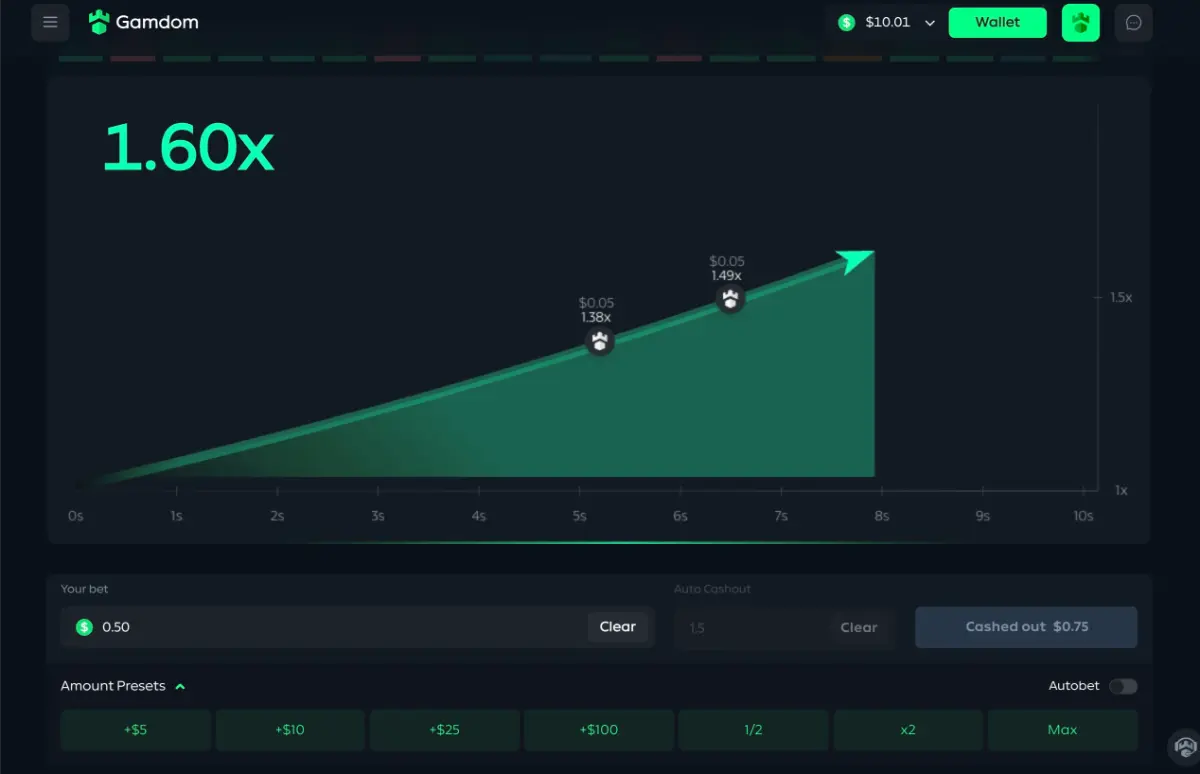
Compared to more modern crash games from the likes of Evoplay, that add subtle visual tension or interactive elements, this feels closer to an early prototype than a finished product.
Bet placement is responsive, and there is no input lag.
Where the effort went
That is the one area where Gamdom clearly invested effort. Even rapid bet adjustments and back-to-back rounds feel smooth.
In terms of features, this game offers less than most crash originals we have reviewed. There is no dual bet system, no split strategies, and no experimental modes.
Compared to Turbo Games’ Crash X, which introduces player progression and extra mechanics, or Stake’s Crash with its refined interface and deep statistics, Gamdom’s version feels almost intentionally limited.
There are no leaderboards on the main screen, no player interaction elements, and no incentives like Drops & Wins or seasonal challenges. That is crash-reduced to its most functional core.
Leaderboard and statistics
This is where the game feels especially thin. There are no public leaderboards for biggest wins, highest multipliers, or daily performance.
For a genre that thrives on social proof and shared excitement, this absence is noticeable.
What you do get is basic game history. You can see past multipliers and access the hash values tied to each round.

That is useful, but it is also where Gamdom shifts responsibility to the player.
There is no in-game fairness verification tool, no visual explanation of how results are generated, and no seed management interface.
If you want to verify fairness, you can. But you need external tools and a solid understanding of cryptographic verification.
Compared to originals from Stake or BC Game that actively guide players through provable fairness checks, Gamdom’s approach feels hands-off to the point of neglect.
Mobile experience
On mobile, the experience mirrors desktop almost exactly. That is both a compliment and a criticism.

Performance is excellent. I tested on both iOS and Android, and the game loaded quickly, stayed stable, and never froze or stuttered. Even on weaker connections, rounds resolved cleanly.
However, the minimalism becomes even more apparent on smaller screens. There is very little visual feedback, and long sessions can feel monotonous.
A pure numbers game
Without leaderboards, animations, or interactive elements, mobile play turns into a pure numbers game.
Button placement is functional, but nothing stands out as especially optimized for touch. The Auto Bet controls work fine, but they are not particularly intuitive for first-time players.
Gameplay options
Manual mode
Manual mode is as simple as crash gets. You set your bet amount, choose whether to auto cash out or not, and click to join the next round.
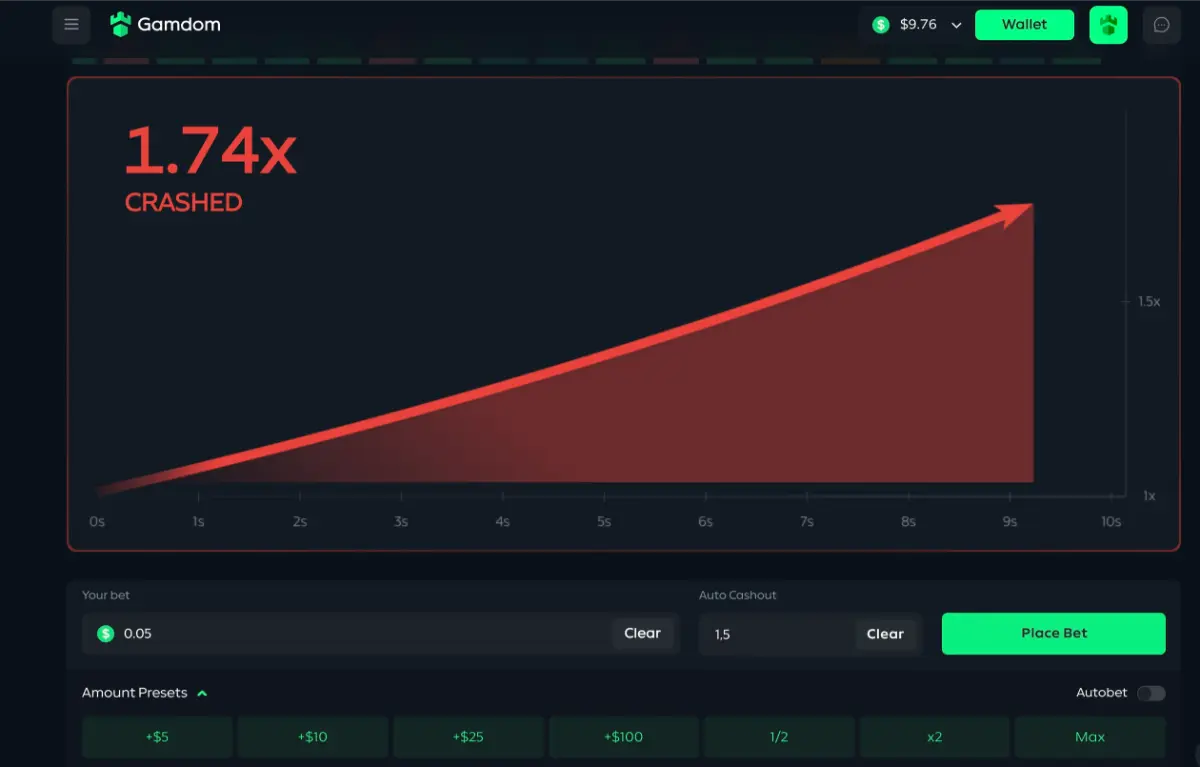
The minimum bet starts at just $0.01, which is great for testing or low-risk grinding.
Room to go big
The max bet is not clearly defined, but the max win is capped at $100,000, which is in line with the other leading casino originals.
There are no extra controls here.
No repeat bet button, no visual reminders, no dynamic risk indicators. You either cash out or you do not.
That simplicity will appeal to purists, but most modern crash players will find it underwhelming.
Auto mode
Auto betting is where Gamdom at least meets baseline expectations.
You can automate rounds, adjust bet size after wins or losses, and stop the betting process when your balance crosses a certain threshold.
These tools are enough to run classic Martingale or Anti-Martingale strategies.

What you cannot do is layer strategies or fine-tune automation beyond these basics.
Compared to crash games that allow multiple stop conditions, split bets, or advanced scripting, this feels limited.
It works, but it does not inspire experimentation.
The automation is stable, though. I ran long auto sessions without errors, skipped rounds, or desync issues. Technically, the system does its job.
Pros & cons of Crash by Gamdom Originals
-
99% RTP, among the best in class
-
Extremely smooth and stable performance
-
Very low minimum bet
-
Automation supports basic Martingale strategies
-
1,000,000x max multiplier
-
Visually bland and uninspiring
-
No leaderboards or community features
-
No in-game provable fairness tools
-
Fairness verification requires external tools
Is Crash by Gamdom Originals worth it?
Crash by Gamdom Originals is maths without theatre: a 99% RTP, penny bets and rock-solid performance, wrapped in a sterile interface with no leaderboards and no in-game fairness tools at all.