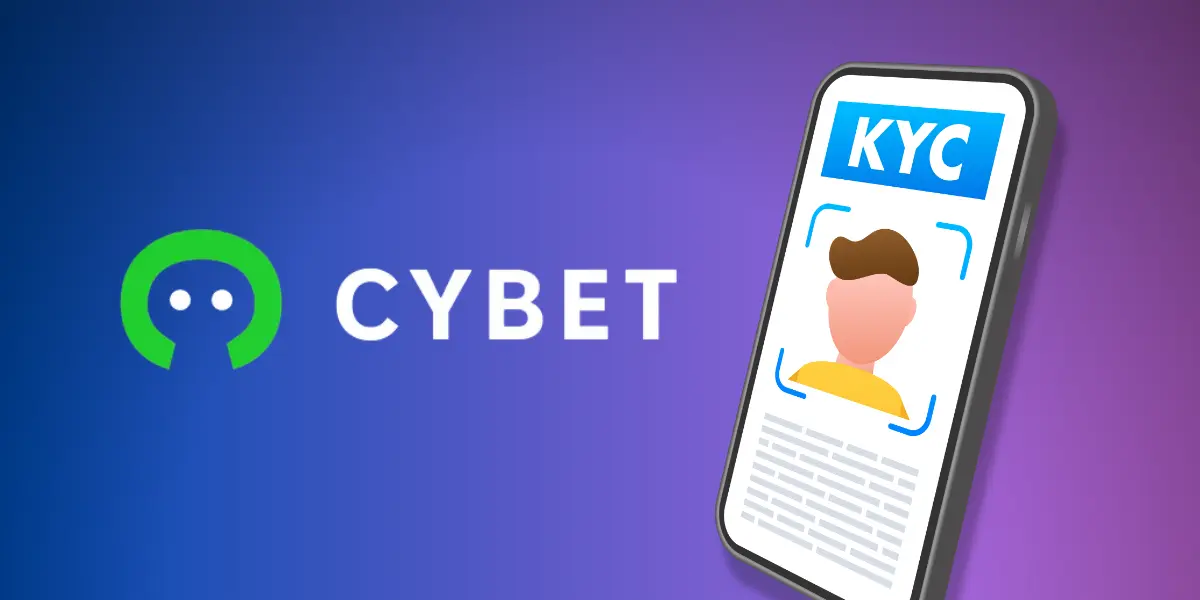

Cybet KYC: Anonymous gambling or not so much?
Cybet launched in 2025 with a slick, Stake-style interface and a crypto-only cashier – but how much does it actually want to know about you?
Unlike Stake or Rainbet, Cybet casino doesn’t publish a neat ladder of verification tiers. Instead, it runs what its terms call a “risk-based compliance framework”, which is the polite way of saying KYC can land on your account at any time.
I read through Cybet’s Terms of Service, poked around the cashier, and messaged support to work out exactly when that happens – and how to stay on the right side of it.

🔑 Key takeaways
- Cybet has no fixed KYC levels – verification is risk-based and can be requested at any time
- Most players can deposit and play, and often withdraw, without uploading a single document
- Large withdrawals, VPN use, and irregular activity are the most common triggers
- Fake details or a failed check can get your funds frozen or your account closed
Does Cybet require KYC?
Yes, but not up front. Cybet is crypto-only and lets you register with just an email and password, so there’s no ID wall at sign-up.
You can fund your account from a $1 minimum deposit and start playing within a minute.
In that sense, it sits closer to Betpanda’s no-KYC approach than to Stake’s stricter KYC, where Level 2 is now mandatory before you can do much of anything.
The catch is that “no KYC at sign-up” is not the same as “no KYC ever.”
Cybet’s terms reserve the right to verify your identity whenever its risk system decides to, and there’s no published threshold that guarantees you’ll fly under the radar.
Cybet runs a risk-based compliance framework – it can request ID, proof of residence, and source-of-funds documents whenever an account is flagged.
In other words, if you get flagged, you’re asked.
How Cybet KYC works
Here’s where Cybet differs from most of its rivals.
Where Rainbet’s four-level system and Stake’s four tiers spell out each step inside your account settings, Cybet keeps the whole thing behind the curtain.
There’s no verification portal with a tidy Level 1-to-4 progression
Compliance checks are triggered case by case, and the documents you’re asked for depend on why your account was flagged.
That opacity cuts both ways. On the upside, plenty of players never see a request at all.
On the downside, you can’t “pre-verify” to guarantee a smooth cashout, and the terms hand Cybet broad discretion to freeze or even confiscate funds it deems high-risk.
If you like knowing the rules in advance, that vagueness is the trade-off for the low-friction sign-up.
What documents does Cybet ask for?
When Cybet does request verification, it draws from the same toolkit as any licensed crypto casino.
Expect one or more of the following:
- Government-issued ID – passport, national ID, or driver’s licence
- Proof of address – a utility bill or bank statement, usually no older than three to six months
- Source of funds – pay slips, bank statements, or similar proof of where your bankroll comes from
Keep clear, well-lit copies ready before you deposit anything serious. Blurry uploads and mismatched names are the fastest way to drag a simple check into a multi-day back-and-forth.
For a full rundown of what each document proves, our crypto casino KYC guide breaks it down.
When does Cybet trigger verification?
Cybet doesn’t list a magic number, but the triggers line up with the wider industry. Verification tends to kick in when:
- You request a large or unusual withdrawal
- You cycle deposits and withdrawals quickly without real gameplay
- Your account shows IP or device mismatches
- The site detects VPN use to get around its geo-restrictions
- Automated AML monitoring flags an irregular pattern
From my own experience, the moment you push above $2,000, you’re asked to verify your account.
At any casino, and Cybet is no exception.
Cybet actively checks for VPNs. Playing around a regional block can put your balance at risk under the abuse clauses – so don’t.
In practice, the trigger is almost always financial. Stick to modest stakes and normal play, and you may cash out without ever uploading a document.
Chase a five-figure jackpot, and you should expect a compliance review before the money moves.
What happens if you fail Cybet KYC?
Cybet’s terms are blunt here. If you can’t verify, or you submit documents that don’t add up, the platform can:
- Suspend your account and freeze withdrawals
- Restrict or refuse pending payouts
- Permanently close the account
- Confiscate funds it links to abuse, fraud, or high-risk sources
On top of that, disputes are settled through binding arbitration rather than a court, and Cybet reserves broad discretion over what counts as “suspicious.”
That’s fairly standard for an Anjouan-licensed brand, but it’s worth reading before you deposit rather than after a payout stalls.
Can you bypass Cybet verification?
No – and I wouldn’t try.
Once Cybet’s system flags you, there’s no trick that makes the request disappear, and fake documents cross the line into fraud.
Your realistic options are to verify honestly or to play somewhere with a genuinely light policy. If anonymity is the priority, our roundup of no-KYC crypto casinos is a better starting point than fighting a licensed operator’s compliance team.
Final thoughts
Cybet’s KYC is lighter than it first looks. There are no forced tiers, no upfront ID wall, and most casual players can deposit, spin, and withdraw without handing over a thing.
The flip side is unpredictability. Because everything is risk-based, there’s no guaranteed safe threshold, and the terms hand Cybet plenty of power over flagged funds.
Play at sensible stakes, skip the VPN, and keep your documents ready, and Cybet’s verification should stay out of your way. Push serious volume, and it pays to verify early – just as it does at Stake or Rainbet.
FAQ
Does Cybet require ID to sign up?
No. You register with an email and password and can deposit from $1 without uploading anything. ID only comes into play if Cybet’s risk system later flags your account – there’s no verification wall at registration.
When does Cybet ask for KYC?
There’s no published threshold. The usual triggers are large or unusual withdrawals, rapid deposit-and-withdraw cycles, VPN use, and IP or device mismatches that its AML monitoring flags. Small, normal-looking play rarely gets a request.
Can you bypass Cybet verification?
Not once you’ve been flagged. Submitting fake documents counts as fraud and can cost you the account and the balance. If you want to avoid checks entirely, a dedicated no-KYC casino is the safer route.