





Our Review
Polymarket Perps is the odd one out in this cluster, and it is the best-built product in it.
Launched on 3 September 2026, it is a real perpetual futures exchange: a central limit order book where you trade against other users rather than against a house, with published maker and taker fees starting at just 0.0400%.
Although leverage tops out at 20x, which sounds feeble next to the 1000x products here, but that is the point. This is an exchange, not a leverage-betting game.
Is it safer trading against other users that against the house? Find out here.
Quick facts
What it is and who runs it
Polymarket spent years as the largest on-chain prediction market, a venue for betting on discrete outcomes: who wins an election, whether a rate cut lands by a given date.
Perps is a different business bolted onto the same brand.
It went live on 3 September 2026 as a perpetual futures exchange covering crypto, equities, indices and commodities, and it is run for international users only.
Polymarket now operates two venues. One is the US-facing event-contract exchange, which is regulated and settles under a CFTC framework.

The other is Perps, which is offshore, unregulated, and closed to Americans. There is no cross-margin between them. A reader who trusts Polymarket because they have seen it covered as the regulated prediction market is trusting the wrong entity when they open a leveraged position here, and any review that blurs the two does them a disservice.
What Polymarket brings that nobody else in this cluster does is genuine market-structure competence.
How it works and liquidation
You deposit crypto to Polygon and it becomes pUSD, an ERC-20 backed by USDC with the backing enforced in the smart contract.
That pUSD is your collateral. You then place orders into a continuous order book with no expiry, choosing cross margin (your whole account backs every position) or isolated margin (each position stands alone).
Liquidation is conventional and, unusually for this cluster, fully published.
Your position is liquidated when account equity falls below maintenance margin.
The maintenance margin rate is 0.5 divided by the market’s max leverage, so a 20x market requires 2.5% maintenance.
Initial margin is tiered: the larger your position, the more margin the system demands, which is a standard defence against one trader building a position the book cannot absorb. Cross positions are assessed together, isolated positions independently.
Once an account is flagged for liquidation, a liquidation fee is charged on top of the normal maker or taker rate.
Compare that with the rest of the cluster, where liquidation means the house closes your bet at a bust price it calculated, and the formula is often undocumented. Here the margin maths is arithmetic you can run yourself before you open the trade.
Markets and leverage
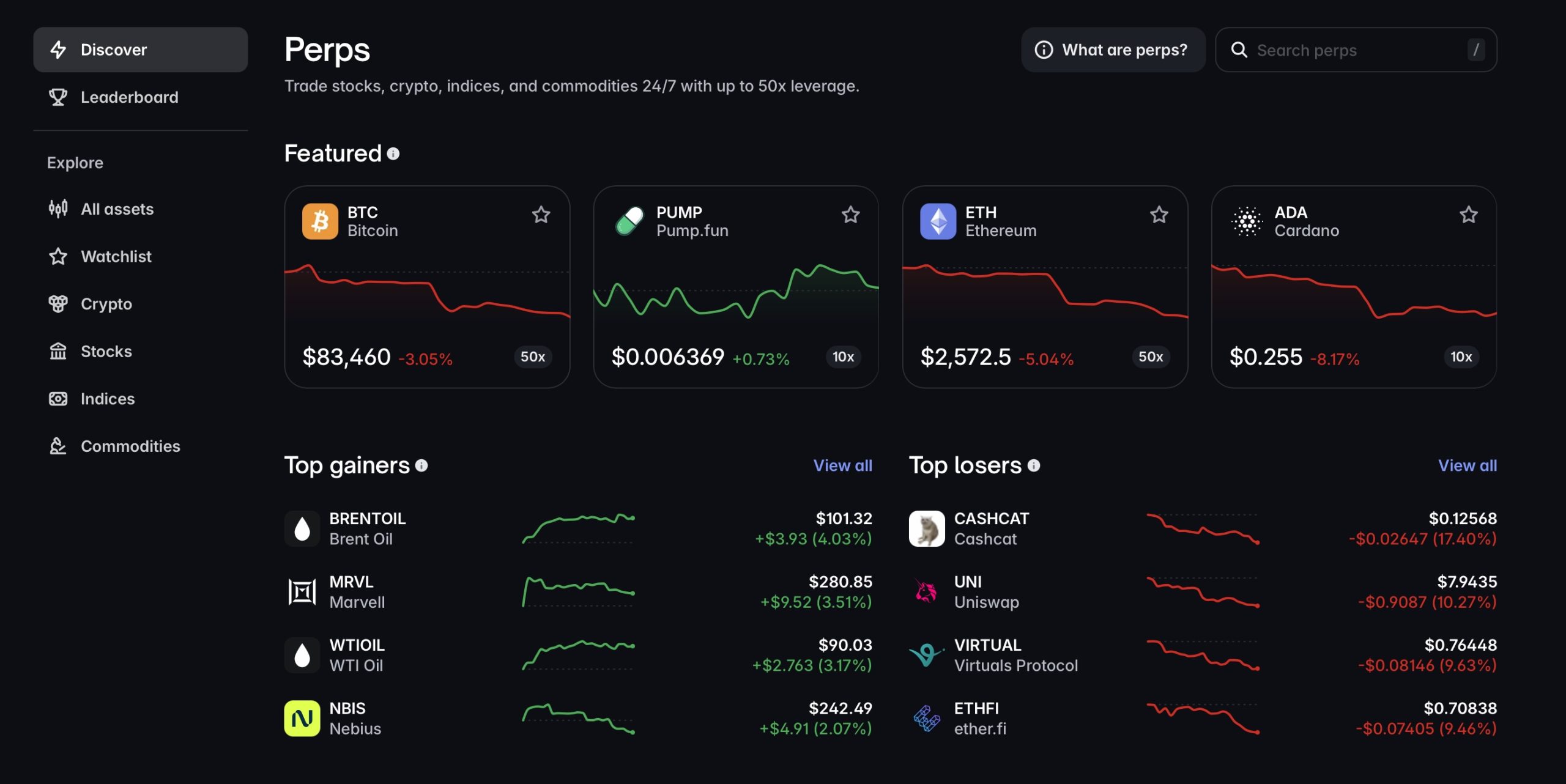
Sixty-seven contracts went live at launch, and the spread is wider than any casino product here:
- 24 crypto contracts including BTC, ETH, SOL and XRP,
- 36 equity-linked markets including Apple, Nvidia, Tesla, Amazon, Meta and Coinbase,
- 3 indices covering the S&P 500 and Nasdaq 100
- 4 commodities in gold, silver, WTI and Brent crude.
Asian equities such as Alibaba and CXMT have been added since. Only Moon.com comes close on breadth, and Moon is a betting platform rather than an exchange.
Leverage caps at 20x on the majors, BTC, the S&P 500, gold, silver and oil, and around 10x on equity and real-world-asset contracts.

Traders arriving from Rollbit or BetFury will see 20x as a downgrade. It is worth explaining why it is not.
At 1000x, a 0.1% move against you ends the position, which makes the product a coin flip with a timer. At 20x with a 2.5% maintenance requirement, a position has room to breathe and the trade is decided by the market rather than by noise.
The low cap is the single clearest signal that this is built as an exchange rather than a game.
Price feed and fairness
This is where Polymarket separates itself from everything else in the cluster.
The mark price tracks multiple external venues, and the premium index that drives funding is sampled every five seconds and averaged over one-hour windows.
There is no house drawing a chart, no synthetic instrument, no RNG mode, and no guaranteed close price set by the operator.
More importantly, there is no house at all.
On a central limit order book your counterparty is another trader. The venue earns fees and funding regardless of whether you win, which removes the structural conflict that sits underneath every other platform in this cluster.
On BC.Game, BetFury, Rollbit, Moon and others, the operator profits when you lose, and the only question is how well it behaves given that incentive. Here the question does not arise.
The honest caveat is the architecture. Matching and margin run off-chain, with periodic state-root commitments posted on-chain.
That is a pragmatic design used by most high-performance perp venues, but it means you are trusting Polymarket’s sequencer between commitments rather than verifying every fill on-chain.
It is materially better than a house-banked black box and materially weaker than a fully on-chain DEX.
Fees and the true cost
The fee schedule is published in full, which by itself puts Polymarket ahead of most of this cluster.
- Takers start at 0.0400% of notional and fall to 0.0370% above $1M of trailing 30 day volume, 0.0250% above $500M and 0.0200% above $1B.
- Makers start at 0.0125%, drop to 0.0100% above $1M, reach zero above $500M and earn a 0.0050% rebate above $1B. Tiers are re-evaluated daily on trailing 30 day volume.
For context, those are exchange-grade numbers.
A house-banked casino product charges an opening fee or a cut of profits and then sets your exit price; the effective cost is often over 1% and sometimes unquantifiable. Paying four basis points as a taker is an order of magnitude cheaper.

Funding is the other cost and deserves attention.
It uses an 8 hour formula with an interest component and clamps, settled once per window, with longs paying shorts when the rate is positive.
The cap is plus or minus 4% per hour, which is a very wide band. In a violently one-sided market, funding can become the dominant cost of holding a position, so this is not a product to leave open and forget.
The liquidation fee charged on top of standard rates when an account is flagged is a third cost worth flagging to readers.
Deposits, withdrawals and payments
Payments are the weakest part of the product for a casino audience. Everything is on-chain on Polygon, converted to pUSD.
There are no fiat rails, no card deposits, no Apple Pay, and none of the fifty-coin menus the casinos in this cluster offer. If your reader is used to depositing with a card at BetFury, this is a step up in friction.
The upside is that withdrawal is a blockchain transaction rather than a request to an operator.
There is no wagering rollover of the kind BetFury applies to futures deposits, no withdrawal limit set by a support team, and no account-closure risk in the casino sense.
The collateral sits in pUSD backed by USDC with backing enforced by the smart contract, so the redemption path is contractual rather than discretionary.
Account, KYC and jurisdictions
Access is wallet-based and no KYC process is documented.
The account model is thoughtful: your main externally owned account signs a one-time proxy creation, and a separate proxy key handles day-to-day trading.
That isolates the key used constantly from the wallet holding your funds, which is a meaningful security improvement over signing every trade with your main wallet.
Geographic restriction is the hard limit.
Order placement is not permitted from the United States, Canada, Cuba, Iran, North Korea, Syria, Crimea, Donetsk or Luhansk, and the terms of service prohibit US persons outright.
Losing both the US and Canada removes a large share of the English-language audience.
Trust, custody and safety
Custody is the strongest argument for this platform.
Your collateral is pUSD on Polygon, an ERC-20 whose USDC backing is enforced by the contract, held against a wallet you control rather than in an operator’s omnibus account. Nothing else in this cluster can say that.
When Rollbit, BetFury or BC.Game holds your balance, you are an unsecured creditor of an offshore company, and MetaWin demonstrated in November 2024 what happens when that goes wrong.
The offsetting risks are specific. There is no proof-of-reserves publication.
The matching engine and margin system run off-chain, so between state-root commitments you are trusting Polymarket’s infrastructure.
The entity operating Perps is not the regulated one, is not CFTC supervised, and its legal structure is not detailed publicly. And the product is weeks old, which means no stress event has tested the liquidation engine, the funding clamps or the withdrawal path under load.
Strong design is not the same as a proven track record.
Bonuses and rewards
There is no casino-style bonus programme, no deposit match, no rakeback and no loyalty token attached to Perps.

The closest thing to a reward is the fee schedule itself: reach $1B of trailing 30 day volume as a maker and you are paid a 0.0050% rebate rather than charged. That is a genuine incentive but one only serious volume traders will ever touch.
Platform and UX
Perps is a web product built around an order book, and it assumes you know what maker and taker mean, what cross margin does and how funding works.
There is no leverage slider theatre, no confetti, no chat.
Traders coming from Rollbit or BetFury will find it plainer and considerably less noisy; traders coming from Binance or Hyperliquid will find it familiar.
Documentation is the standout: full fee tiers, the funding formula, the maintenance margin calculation and the restricted-country list are all published, which is rare in this cluster and reflects well on the operator.
Reputation and user sentiment
Polymarket the brand carries real weight. It became the largest on-chain prediction market, drew mainstream financial press coverage, and has institutional attention. That reputation is earned by the prediction market, not by Perps.
Perps itself launched on 3 September 2026 and has no meaningful user track record yet: no dispute history, no withdrawal-complaint pattern, no evidence of behaviour during a liquidation cascade.
Treat any confident claim about its reliability, ours included, as provisional. The most useful thing to tell readers is that the brand is credible and the product is unproven, and those are two separate facts.
Pros & Cons
-
No house. A central limit order book means you trade against other users.
-
Exchange-grade fees, from 0.0400% taker down to a maker rebate.
-
Self-custody collateral in pUSD on Polygon, backed by USDC contract.
-
Fully documented margin and funding math.
-
Sensible account security, with a trading proxy key separated from the fund-holding wallet.
-
Broad market coverage: 67 contracts spanning crypto, single stocks, indices and commodities.
-
No wagering rollover, no operator-set withdrawal limits, no discretionary account closure.
-
Not CFTC-regulated, and deliberately separate from the regulated Polymarket.
-
The US and Canada are blocked outright, along with sanctioned territories.
-
Launched September 2026, so there is no payout or stress-event track record.
-
Matching and margin run off-chain, so you trust the operator between on-chain commitments.
-
No proof-of-reserves published.
-
Funding is capped at a very wide plus or minus 4% per hour, which can dominate cost in one-sided markets.
-
Crypto-only payments on Polygon, with no fiat or card rails.
-
No bonuses, rakeback or loyalty rewards to speak of.
How Polymarket Perps compare
| Platform | Deposit options | Max leverage | Price feed | Counterparty | Custody | Headline cost |
| Polymarket Perps | Polygon, crypto only | 20x | Real, multi-venue mark price | Peer-to-peer order book | Self-custody pUSD on Polygon | Taker from 0.0400%, maker rebate at top tier |
| BetFury Futures | Crypto + fiat | 1000x | Real weighted average, plus a FuryWaves RNG mode | House-banked | Operator-held | Flat or P&L fee, 60% off with BFG |
| Moon.com | Crypto deposits | 1000x | Real (DXFeed, Pyth, SEDA) | House-banked | Operator-held | 1% opening fee on wager only |
| BC.Game Crypto Futures | Crypto + fiat | About 1250x | Real market data via Detrade | House-banked | Operator-held | [unconfirmed] |
| CoinFutures | Crypto | 1000x | Algorithmic simulation | House-banked | Operator-held | PnL fee or flat fee |
| MetaWin HODL | Crypto + fiat | 1000x | Real, on-chain bets | House-banked | Wallet-connect | Undocumented |
| Rollbit Futures | Crypto + fiat | 1000x | Real composite index across major exchanges | House-banked | Operator-held | PnL fee or flat fee, RLB discount |
Verdict
Polymarket Perps amazed us due to the fair mechanics, low cost and safe custody. It is not a better version of Rollbit; it is a different product that happens to answer the same reader question.
Are Perps worth it?
If you don’t want to trade inside a casino environment that is governed by the ‘house’, then Perps by Polymarket are the way to go.
FAQ
Is Polymarket Perps the same as Polymarket?
No, and this is the most important thing to understand. Polymarket runs two separate venues. The prediction market that US users know is regulated and settles event contracts. Perps is an offshore, unregulated leveraged derivatives exchange for international users only, with no cross-margin between the two.
Can I use Polymarket Perps in the US?
No. Order placement is not permitted from the United States or Canada, and the terms of service prohibit US persons. Cuba, Iran, North Korea, Syria, Crimea, Donetsk and Luhansk are also blocked.
Is it regulated?
The perps venue is not CFTC-regulated. Polymarket’s US event-contract exchange operates under a CFTC framework, but that regulation does not extend to this product.
What leverage can I get?
Up to 20x on majors including BTC, the S&P 500, gold, silver and oil, and about 10x on equity and real-world-asset contracts. That is deliberately far below the 1000x offered by casino trading games, because this is an exchange rather than a betting product.
What are the fees?
Takers pay 0.0400% of notional at the lowest tier, falling to 0.0200% above $1B of trailing 30 day volume. Makers pay 0.0125%, falling to a 0.0050% rebate at the top tier. Tiers reset daily on trailing 30 day volume. Funding is charged on an 8 hour cycle and capped at plus or minus 4% per hour, and a liquidation fee applies on top if your account is flagged
Who holds my money?
You do. Collateral is pUSD, an ERC-20 on Polygon backed by USDC with the backing enforced by the smart contract, held against a wallet you control. Your main wallet signs a one-time proxy creation and a separate trading key handles day-to-day orders.
Am I betting against the house?
No. It is a central limit order book, so your counterparty is another trader. Polymarket earns fees and funding either way, which is why this scores far higher on fairness than the house-banked products in this cluster.