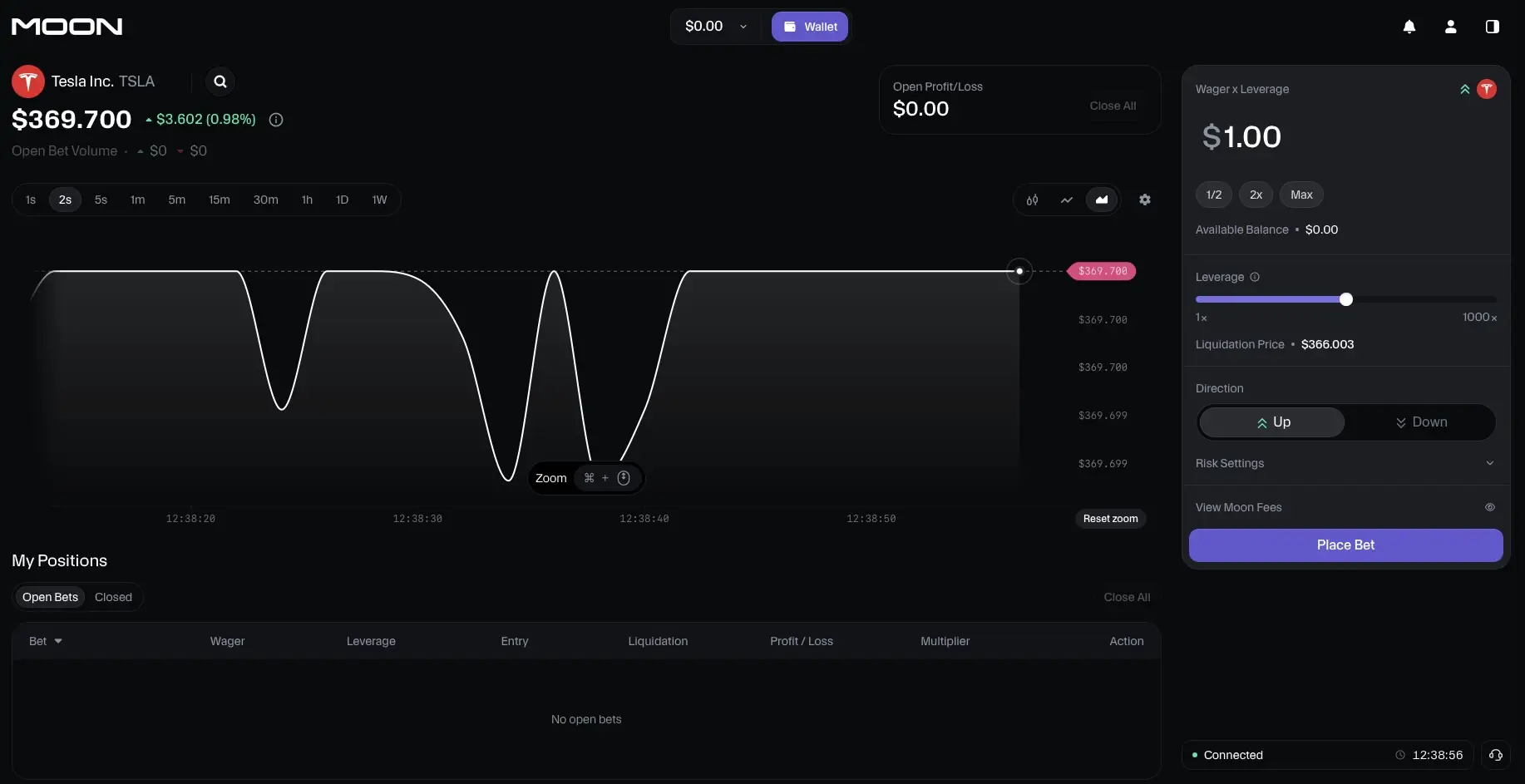






Our Review
Moon.com is a house-banked betting platform where you bet Up or Down on real crypto, stock, commodity, index and forex prices with leverage from 1x to 1000x, and the most you can ever lose is the amount you stake.
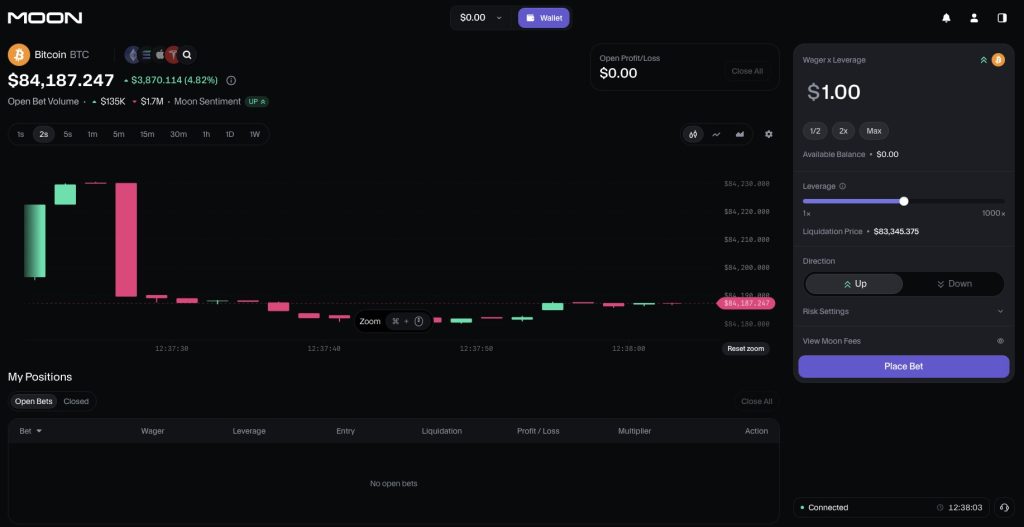
It is cheap to open a position, genuinely loss-capped, and it runs on real market data. It is also brand new (public since 28 August 2026), licensed only in Anjouan, and structurally built so the house wins on average.
Quick facts
What Moon.com is, and who runs it
Moon.com is an online market-betting platform or trading game as we like to call it.
You pick an asset, choose Up or Down, set a stake and a leverage multiplier, and you win or lose based on which way the price moves. You never own the underlying coin or share.
Every position is a wager against Moon itself, which the terms describe as a “speculative entertainment product,” not an investment or a security.
It is run by Moon International Limited, registered in Hamchako, Mutsamudu, Anjouan (company registration #16151), with terms governed by Comoros law.
The product went public on 28 August 2026, so at the time of writing it is only a few weeks old. One thing to clear up because people keep asking: Moon.com is not a Stake product.
There is no ownership link in any document we could find, and Curacao, where Stake operates, sits on Moon’s own list of blocked jurisdictions.
How it works, and how you get busted
The core loop is one tap. Select a market, hit Up or Down, type a stake, drag the leverage from 1x to 1000x, and confirm.
Before you confirm, Moon shows you two numbers that matter: your multiplier (what the position pays per unit of price move) and your bust price (the level at which the position auto-closes as a loss). You can close a winning or losing position manually at any time, 24/7.
The mechanic people care about is the downside, and here Moon is genuinely different from a real exchange.
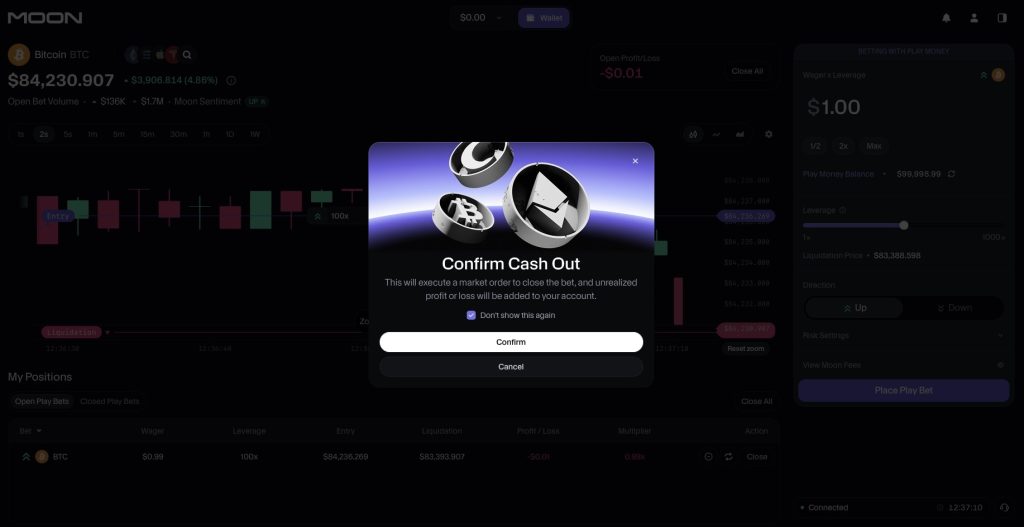
Your stake is your maximum loss. When the market reaches your bust price, the position closes automatically and your loss is capped at what you put in.
There are no margin calls and no negative balances. The catch is on the other side of that promise: Moon settles at its own quoted price, and the terms allow settlement at a price worse than the last quote you saw. So the bust is clean, but the exact exit is Moon’s to price.
A quick walkthrough:
- You stake $100 on Bitcoin Up at 100x.
- That controls $10,000 of exposure.
- If BTC rises about 1%, your position is up roughly $100 and you can close for a gain.
- If BTC falls about 1%, you hit your bust price, the position closes, and you are out your $100 and nothing more.
At 1000x, a move of a tenth of a percent does the same job, which is exactly why the high multipliers are a fast way to lose a stake.
Markets and leverage
The multi-asset range is Moon’s clearest advantage over the crypto-only competition.
At last check it covered roughly 19 cryptocurrencies (BTC, ETH, SOL, XRP, DOGE, HYPE and more), about 13 US stocks (TSLA, AAPL, NVDA, AMD, MSFT and others), four metals (gold, silver, platinum, palladium), the Nasdaq 100 and S&P 500 indices, and major forex pairs such as EUR/USD and GBP/USD.
That is around 38 instruments across five asset classes, all bettable with the same Up or Down mechanic.
Leverage runs from 1x to 1000x and the available ceiling varies by market and conditions.
Order tooling is deliberately thin: this is up, down, leverage and a manual close, not a full trading terminal with stop-loss and take-profit orders. New users get a real advantage that Rollbit and BC.Game do not offer, a demo mode preloaded with $100,000 in play money, so you can learn how fast a 1000x position moves before risking anything.
Price feed and fairness
Moon prices its markets off real third-party feeds: DXFeed, Pyth Network and SEDA Protocol. That is a point in its favor and worth stating plainly, because it means the charts track the actual market rather than an in-house random number generator.
There is no provably-fair seed to check here, and there does not need to be, because the prices are real.
The fairness question is not the feed, it is what Moon does with it. Two things to flag. First, there is an undisclosed house spread built into the settlement price (referenced in the terms at sections 5.4 and 9.2 but never quantified), so the price you trade against is not the raw feed.
Second, as noted above, Moon can settle a closing position at a price worse than the last quote you saw. Neither is unusual for a house-banked product, but both mean the deck is tilted by design, and the size of the tilt is not published.
Fees and the true cost
Moon publishes most of its fees, and on paper they are competitive:
- Opening fee: 1% of your stake, not your exposure. Opening a $100 wager costs $1 whether you run it at 2x or 1000x. This is the genuinely cheap part and Moon markets it hard.
- Holding fee: a dynamic fee charged every 8 hours on stake plus leverage. The rate is shown live in the app but is not published in advance, and it is charged on the leveraged size, so it adds up on anything you hold for hours.
- Performance fee: a minimum 10% of your realized profit, charged on winning bets only. Losing bets pay nothing extra.
- Spread: the undisclosed house spread inside the settlement price, on top of the above.
- Rakeback: 3.5% of all fees credited back through a referral code, which softens the total slightly.
Worked example:
You stake $100 on a 100x position, controlling $10,000.
It goes your way and you close with $60 of gross profit. Your visible fees are the $1 opening fee plus 10% of the $60 profit, which is $6, so about $7 before the two costs you cannot see in advance: the 8-hourly holding fee on the $10,000 exposure and the spread. Budget several percent more for those on anything held for hours.
On a losing trade, you pay the $1 to open and lose your $100 stake, and that is the end of it. Net: cheap to enter, cheap to lose, and the real cost of winning depends on the holding fee and spread you have to read on the day rather than the headline 1%.
Deposits, withdrawals and payments
Funding is crypto and on-chain: BTC, ETH, SOL, USDT, USDC and others, credited after network confirmation.
There is no confirmed fiat or card rail on the core product at the time of writing.
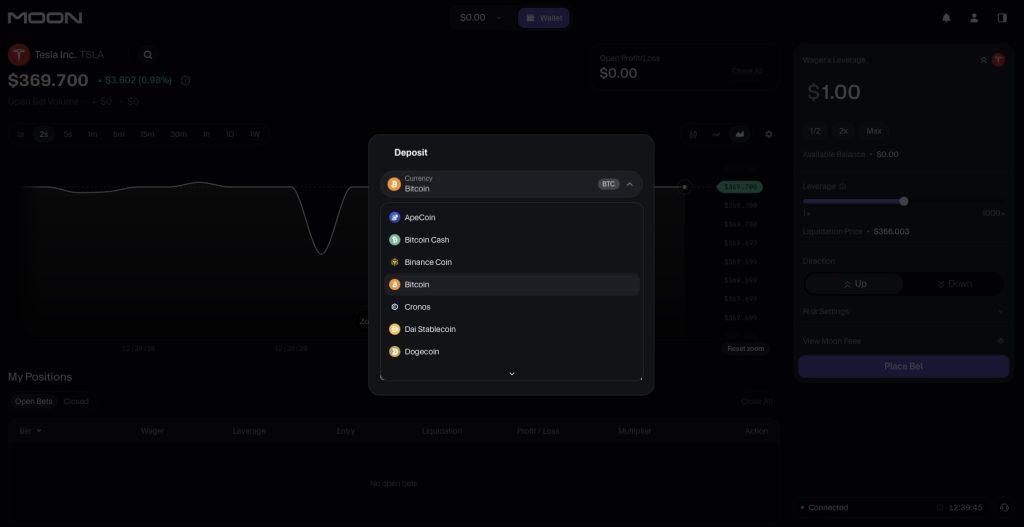
Withdrawals are where a new house-banked platform earns or loses trust, and Moon is unproven here. Withdrawals are also screened before release, with reports of an automated review of betting history against criteria Moon does not publish.
Account, KYC and jurisdictions
Moon requires full KYC: name, date of birth, address, government ID and source of funds, with verification enforced before your first withdrawal.
This is not an anonymous, no-KYC platform, which rules it out for privacy-first players and points them to something like CoinPoker instead.
Access is heavily gated. Around 44 jurisdictions are blocked in the terms (section 3.2), including the US, UK, Australia, the Canadian province of Ontario, France, Germany, Italy, Spain and the Netherlands.
VPN use to get around the geoblock is a material breach that can get your account closed and, realistically, your balance frozen. The minimum age is 18, or higher where local law demands it.
Trust, custody and safety
The good news on trust is that the license is real and checkable.
Moon runs on Anjouan license ALSI-202601063-FI2 from the Offshore Finance Authority, issued 31 January 2026 and valid to 30 January 2027, and it resolves in the public register at anjouangaming.com.
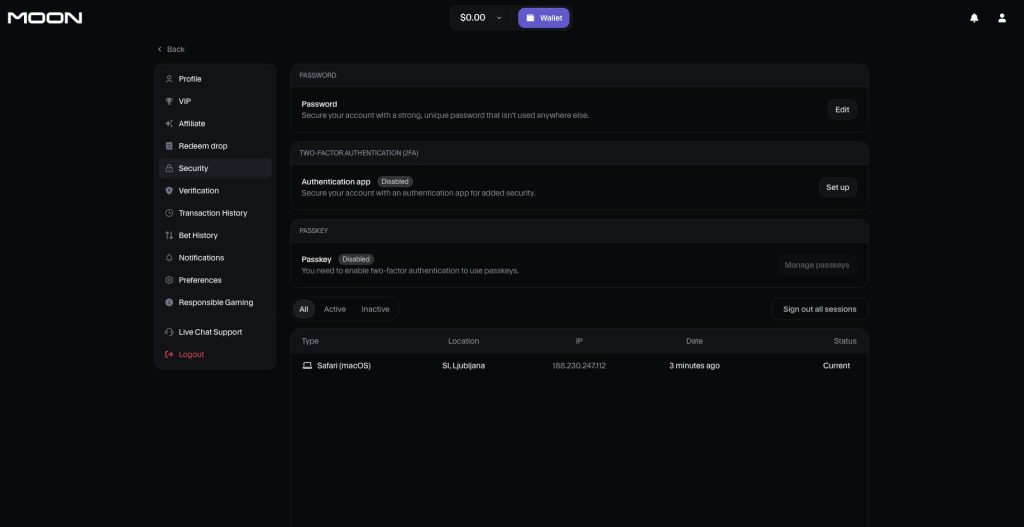
The security basics are present too: 2FA, biometric login, session management, a vault for idle funds and time-out tools.
Moon is the direct counterparty to every bet, so it profits when you lose, which makes every position negative expectation by design.
Funds are house-held with no published proof-of-reserves, the operator sits in a light-touch offshore jurisdiction, and the platform is only weeks old with almost no track record to lean on.
An Anjouan license is a real license, but it is not the consumer protection you would get from a tier-one regulator. None of this makes Moon a scam. It makes it licensed, transparent about most of its terms, and unproven.
Bonuses and rewards
Sorry for the bad news!
There is no traditional deposit-match bonus.
The reward that matters is the 3.5% rakeback on all fees, applied through a referral code, which is a small ongoing discount rather than a headline offer.
Moon also runs a VIP club with tiers gated by wagered volume (reported thresholds run from around $10,000 up to $1 billion), unlocking loyalty perks as you bet more. For a trading product, the rakeback is the number to care about; the VIP tiers reward volume, which for a leveraged product is a double-edged incentive.
Platform and UX
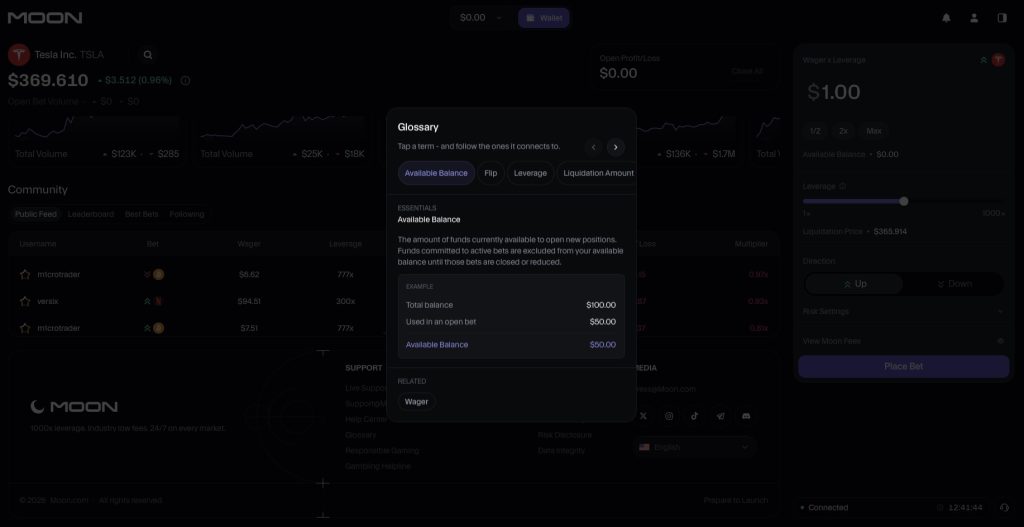
The interface is the strong part. It is a clean, fast, one-tap web app that works 24/7, with a set of social features stacked on top:
- a live market-sentiment bar
- a real-time feed of other users’ bets, leaderboards and
- a follow function so you can track other bettors.
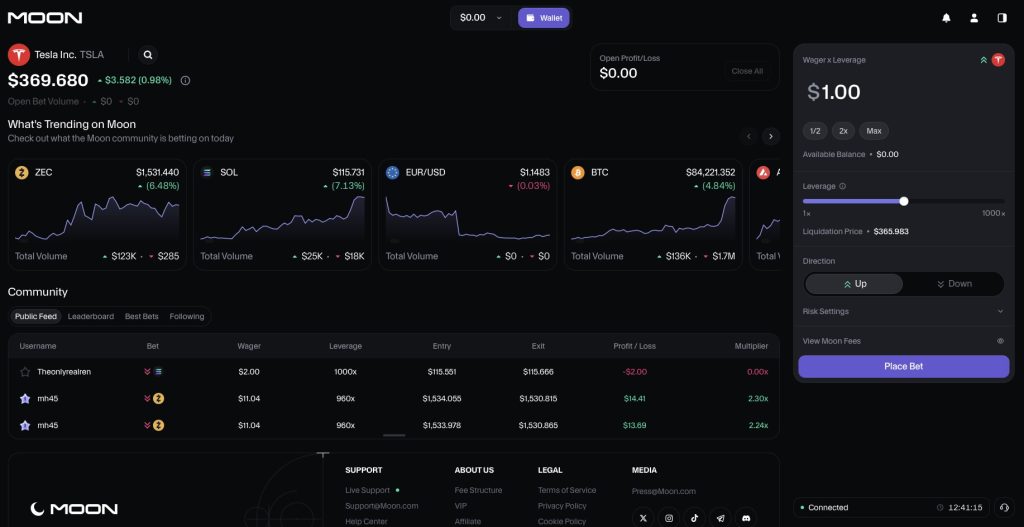
Combined with the $100,000 demo, onboarding is genuinely easy for a product this risky. The main gap is that it is web only, with no native mobile app reported yet.
Reputation and user sentiment
This is the weakest section, and honestly so.
Moon.com is too new to have a real reputation. Independent coverage is thin: Traders Union rates it 3.7 out of 5 (“Good”) but off just 12 Trustpilot reviews, and flags a tiny third-party footprint (a single referring domain and very low traffic).
There is no established payout track record, no long complaint history to mine, and no large-forum body of evidence yet. The recurring theme across every serious write-up is the same: licensed and plausible, but verify independently and start small.
We agree, and we will update this block once we have run money through it ourselves.
Pros & Cons
-
Losses are genuinely capped at your stake, with no margin calls or negative balances.
-
Real price feeds (DXFeed, Pyth, SEDA), not a random number generator.
-
Multi-asset: crypto, stocks, indices, commodities and forex in one place.
-
Cheap to open, 1% on the stake rather than the leveraged exposure.
-
A $100,000 demo mode, which almost no competitor offers.
-
License is real and verifiable in the Anjouan public register.
-
House-banked, so every bet is negative expectation by design.
-
Undisclosed spread inside the settlement price, and settlement can be worse than the last quote.
-
Brand new (August 2026) with almost no payout track record.
-
Withdrawals are screened and unproven at size.
-
Full KYC and around 44 blocked countries; VPN use can close your account.
-
No proof-of-reserves and only an offshore Anjouan license.
How Moon compares
| Dimension | Moon.com | Rollbit | BC.Game (Futures) |
| Model | House-banked leverage betting | House-banked (synthetic) | Casino-hosted trading |
| Markets | Crypto, stocks, indices, commodities, forex | Crypto only (60+) | Crypto and meme coins |
| Max leverage | Up to 1000x | Up to 1000x | Up to ~1250x |
| Price feed | Real (DXFeed, Pyth, SEDA) | Real (synthetic vs house) | Real market data |
| Demo mode | Yes ($100k) | No | No |
| KYC | Full | Above threshold | Yes |
| Live since | August 2026 | 2020 | Established |
Read the fuller head-to-head in our Moon.com vs Rollbit vs BC.Game comparison, and the individual Rollbit and BC.Game trading reviews.
In one line: Moon wins on markets, loss-capping and a demo; Rollbit wins on track record and an established casino wrapper; BC.Game wins on being a trading mode inside a casino you may already use.
Verdict
Moon.com is a legitimately licensed, genuinely loss-capped, cheap-to-enter leverage-betting product with a real multi-asset feed and a rare demo mode.
It is also house-banked, priced with a spread it will not disclose, and only a few weeks old with no proven payout history at size.
Is Moon.com worth it?
If you’re looking to trade on various assets without the complications of real trading platforms, Moon.com is the way to go.
FAQ
Is Moon.com legit?
It holds a real, verifiable Anjouan gaming license (ALSI-202601063-FI2) and publishes its terms, so it is a licensed operator rather than an obvious scam. But it launched in August 2026, holds funds itself with no proof-of-reserves, and is unproven on large withdrawals, so “legit but unproven” is the honest answer.
Is Moon.com rigged?
Prices come from real feeds (DXFeed, Pyth, SEDA), so the charts are not made up. The house edge is real and legal, though: an undisclosed spread sits inside the settlement price and Moon can settle worse than the last quote. You are betting against the house on a negative-expectation product by design.
Does Moon.com need KYC?
Yes. It asks for ID, date of birth, address and source of funds, and verification is enforced before your first withdrawal.
What are the fees?
A 1% opening fee on your stake, a dynamic holding fee every 8 hours on stake plus leverage, a minimum 10% performance fee on profit from winning bets, and an undisclosed spread. You get 3.5% rakeback on fees via a referral code.
What countries are blocked?
Around 44, including the US, UK, Australia, Ontario, France, Germany, Italy, Spain and the Netherlands. Using a VPN to get around it can close your account.
Can I lose more than I put in?
No. Your stake is your maximum loss. Positions auto-close at the bust price with no margin calls and no negative balance.
Is there a demo?
Yes, a practice mode with $100,000 in play money, which is a good way to feel how fast a high-leverage position moves before you risk real funds.
Is Moon.com owned by Stake?
No. It is operated by Moon International Limited in Anjouan, and Curacao (Stake’s base) is on Moon’s own blocked list.