







Our Review
Rollbit Futures is the leveraged crypto trading product inside Rollbit, one of the longest-running crypto casinos.
You bet Up or Down on real crypto prices with up to 1000x leverage, against Rollbit as the counterparty with no order book, and your loss is capped at your stake.
These two paragraphs alone set the standards high for Rollbit, and we’ve been digging and trading their Futures to bring you the real picture.
Quick facts
What it is and who runs it
Rollbit Futures is not a standalone platform.
It is the leveraged trading tab inside Rollbit, a crypto casino and sportsbook that has been running since 2020. You are not opening a position on a real exchange. You are placing a synthetic wager on which way a crypto price moves, settled against Rollbit, with no order book behind it.
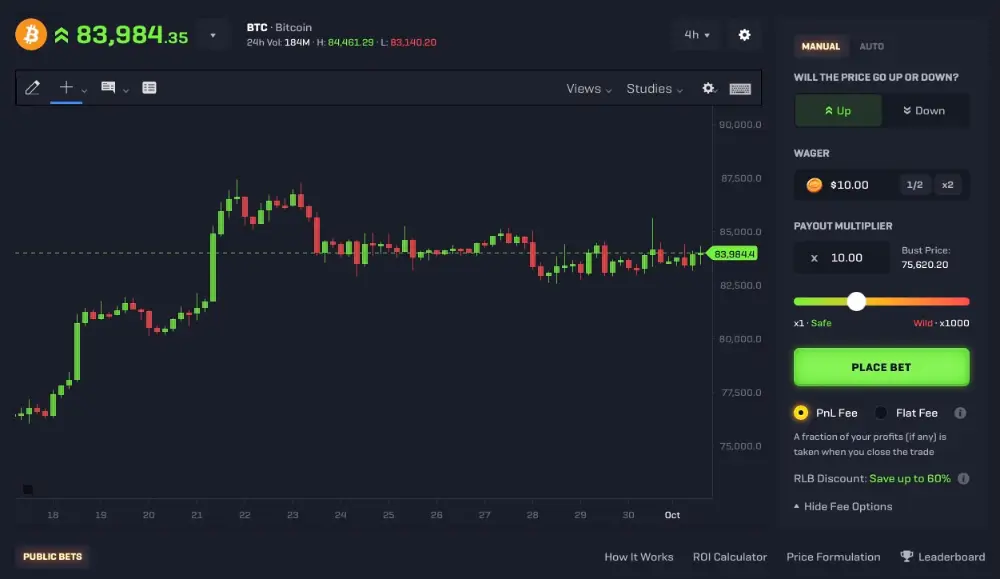
Rollbit is the counterparty to every trade.
The operator is Bull Gaming N.V., registered in Curacao (#157086) under a Curacao Gaming Authority license (OGL/2024/1260/0494).
The founders are known only by the handles Lucky and Razer and are otherwise anonymous.
Rollbit also runs the RLB token on a buy-and-burn model, which powers its fee discounts and rewards. That token has burned roughly 68% of its original 5 billion supply but trades near six cents, more than 75% below its 2023 peak, so the ecosystem incentive is weaker than it was.
How it works and liquidation
The trading terminal itself is simple. Pick a crypto market, choose Up or Down, set your leverage up to 1000x, and place the bet.
You can attach a take-profit and a stop-loss, and close manually whenever you like.
Positions fill immediately at the displayed price because there is no order book to match against; Rollbit simply quotes you a price and takes the other side.
On the downside, your loss is capped at your stake. A synthetic liquidation closes the position against your margin rather than letting you go negative.
The number to respect is the leverage math: at 1000x, a 0.1% move against you wipes the stake, so the top multipliers are a near-instant way to lose. Rollbit also throttles the maximum leverage down on more volatile assets, and it caps position sizes ($1,000,000 aggregate by default, less on smaller alts), with larger limits available on request within about 24 hours.
Markets and leverage
Rollbit Futures is crypto only.

You can trade over 20 cryptocurrencies, with Bitcoin, Ethereum and the majors carrying the full leverage and position limits, and smaller altcoins like ApeCoin and Pepe carrying lower caps (around $300,000).
There are no stocks, commodities, indices or forex here, which is the clearest gap versus Moon.com.
Leverage runs up to 1000x, dialled down automatically on volatile assets. Tools are better than a pure up-down product: you get take-profit, stop-loss and a leaderboard, but there is no demo or practice mode, so you are learning on real money from the first trade.
Price feed and fairness
Rollbit prices its markets off real crypto prices, so the direction you are betting on is the real market, not an RNG.
What makes it different from an exchange is that execution is fully synthetic: there is no order book, no other traders, just Rollbit quoting a price and being your counterparty. That keeps it simple and instant, and it means Rollbit profits directly when you lose.

The fairness caveat is not the feed, it is the trust model. Because it is synthetic and house-banked, you cannot verify your fill against a public book, and the complaint patterns we’ve seen (accounts frozen after wins) is exactly the kind of thing that matters more when the house both makes the price and holds the funds.
The prices are real; the accountability is only as good as the operator, and here that is contested.
Fees and the true cost
This is where Rollbit is genuinely better than most of its rivals: the fees are actually documented, and you get to pick your model.
- Flat Fee: a fixed 0.04% (4 basis points) on entry and again on exit, plus a slippage fee that scales with position size. Predictable, and good for larger or shorter trades.
- PnL Cut: no upfront fee at all. Instead Rollbit takes a percentage of your profit, scaled by position size, holding time and leverage. Good for small or speculative trades where you would rather pay only if you win.
- RLB discount: paying fees with the RLB token cuts them by up to 60%.
- Funding: positions held past 8 hours accrue hourly funding payments based on market conditions.
Worked example:
- You open a $100 position at 100x on Bitcoin, controlling $10,000.
- On the Flat Fee model you pay 0.04% to open and 0.04% to close, so about $4 each way on the $10,000 exposure, roughly $8 round trip before slippage and any funding, and less if you pay in RLB.
- On the PnL Cut model you pay nothing to open and instead give up a slice of any profit.
Either way, if you lose, your downside is your $100 stake. The takeaway: unlike BC.Game’s hidden winning-close edge, you can actually price a Rollbit trade before you place it, which is a real point in its favour.
Deposits, withdrawals and payments
Deposits are crypto only: BTC, ETH, SOL, USDT, USDC and LTC, with no deposit fees beyond network costs.
In testing, small withdrawals clear within minutes, so on the easy path the cashier is fast.
The hard path is the problem, and it is the single biggest mark against Rollbit. The recurring complaint across dispute boards is not slow payouts on small sums, it is accounts getting frozen and hit with escalating document requests specifically after wins or larger withdrawal attempts, with support going quiet during the dispute.
Identity verification is required at withdrawal, and risk-based reviews can ask for proof of address or source of funds. None of that is unusual on its own, but the volume and consistency of the “frozen after winning” pattern is.
Account, KYC and jurisdictions
Signing up and depositing needs no documents, so getting started is easy.
The catch is that verification lands at withdrawal, which is where the friction shows up, potentially. Rollbit blocks 29 jurisdictions, including the US, France, Germany, Spain, Italy, the Netherlands and Australia. The minimum age is 18.
Like we said before, KYC is triggered on a case to case basis, with big withdrawals obviously catching more attention. This is standard practice in Curacao licensed casinos, so I’m not surprised. Rollbit carries a good track record and our own in-depth review provided evidence for that.
Trust, custody and safety
Rollbit’s trust case is a genuine split. In its favour: it has operated since 2020, it is one of the larger crypto casinos, small withdrawals are fast, and the futures product is technically slick. It also publishes its fee models clearly, which many rivals do not. Our in-depth review also proved the platform is trustworthy.

Against it: the operator runs on a Curacao gaming license with no financial regulator over the trading product, the founders are anonymous, there is no proof-of-reserves, and funds are fully house-held while the house is also your trading counterparty.
Bonuses and rewards
There is no deposit-match bonus aimed at traders alone.
Rewards are activity-based rakeback, boosted in your first 24 hours after signup and after claiming certain bonuses, and the headline saving is the up-to-60% fee discount for paying in RLB.
That discount is real, but it ties your costs to a token that has fallen more than 75% from its peak, so the value of the RLB incentive is not what it was in 2023. For a futures player, the fee discount is the part worth caring about; the rest is standard casino rakeback.
Check the rest of the bonuses at Rollbit on the bonuses section of our review.
Platform and UX
The product experience is one of Rollbit’s strengths.

The futures interface is fast and clean, with leverage, take-profit, stop-loss and a live leaderboard in one view, sitting alongside a full casino and sportsbook under a single balance.
It is web-based with no native app reported. The industry leading UX is a clear selling point; as it is, it is a polished front end on a contested operator.

Pros & Cons
-
Up to 1000x leverage on majors, with take-profit and stop-loss.
-
Two clear fee models (Flat Fee or PnL Cut) that you can price before you trade.
-
Up to 60% fee discount when paying in RLB.
-
Established since 2020 with a fast, slick interface and a full casino and sportsbook attached.
-
No KYC to sign up or deposit; small withdrawals clear in minutes.
-
House-banked and fully synthetic, with no order book to verify fills against.
-
Anonymous founders, no proof-of-reserves, and no financial regulator over the trading product.
-
Crypto only, no demo mode, and RLB rewards tied to a token down 75%+ from its peak.
-
Only trading on crypto pairs
How Rollbit compares
| Dimension | Rollbit | Moon.com | BC.Game |
| Model | House-banked (synthetic, no order book) | House-banked leverage betting | Casino-hosted trading |
| Markets | Crypto only (20+) | Crypto, stocks, indices, commodities, forex | Crypto pairs |
| Max leverage | Up to 1000x | Up to 1000x | Futures 2x to 50x+ |
| Fees | Documented: 0.04% flat or PnL cut | 1% open + 10% on profit + spread | No visible fee; hidden winning-close edge |
| Price feed | Real (synthetic execution) | Real (DXFeed, Pyth, SEDA) | Real (single price, no spread) |
| Demo mode | No | Yes ($100k) | No |
| Reputation | Poor (Trustpilot ~2.4) | Too new to rate | Mixed (2024 bankruptcy) |
| Live since | 2020 | August 2026 | 2017 (casino) |
Rollbit has the most transparent fees and a long operating history, but the worst payout reputation in the group; Moon.com is newer and cleaner but unproven; BC.Game is fast and established with its own 2024 baggage.
See the individual Moon.com and BC.Game reviews and the Moon vs Rollbit vs BC.Game comparison for the full head-to-head.
Verdict and scorecard
Rollbit Futures is a good trading product attached to an operator you have to think hard about. The mechanics are clean, the leverage is real, the fees are the most transparent in this cluster, and small cashouts are quick.
Is Rollbit Futures worth it?
As far as in-casino trading goes, Rollbit is as reliable and trustworthy as Curacao licensed casinos come. That being said, their fee structure alone makes this a worthy trading game.
FAQ
What is Rollbit's trading game called?
It is called Futures, marketed as “1000x Leverage Crypto Futures.” There is no separate game name; it is the Futures tab inside the Rollbit casino.
Is Rollbit Futures rigged?
Prices are real crypto prices, not RNG, so the direction is genuine. But execution is fully synthetic against the house with no order book, and Rollbit profits when you lose, so you are trusting the operator rather than a verifiable market.
Does Rollbit need KYC?
Not to sign up or deposit. Identity verification is required at withdrawal, and risk-based checks can request proof of address or source of funds.
What are the fees?
Two models: a Flat Fee of 0.04% on entry and exit plus slippage, or a PnL Cut that takes a percentage of profit instead. Both are up to 60% cheaper if you pay in the RLB token. Funding applies on positions held past 8 hours.
What leverage does Rollbit offer?
Up to 1000x, reduced automatically on volatile assets. At 1000x a 0.1% move against you wipes your stake.
Can I lose more than I stake?
No. Positions are liquidated synthetically against your margin and your loss is capped at your stake, with no negative balance.
What countries are blocked?
29 jurisdictions, including the US, France, Germany, Spain, Italy, the Netherlands and Australia.