
Can Bitcoin casinos refuse to pay out?
You sign up at a shiny new crypto casino, deposit in minutes, hit a nice win, and then… nothing. The withdrawal sits there. Support gets vague.
Suddenly, there’s a “verification review” you never heard about at deposit.
If that scenario makes your stomach drop, you’re not being paranoid. It happens more than the industry likes to admit.
🔑 Key takeaways
- Most refusals come from KYC failures, multiple accounts, restricted locations, or unmet wagering requirements – and many are avoidable.
- “No KYC” advertising is often a trap: verification gets triggered only when you try to withdraw a big win.
- If a site won’t pay, you’re not powerless – gather your evidence, escalate to the casino’s regulator or its dispute-resolution body, and make the complaint public.
Why casinos refuse to pay
Let’s clear up one thing first.
A casino refusing a payout isn’t always a scam.
Sometimes you broke a rule, and the site is within its rights to void the win. Other times, the “rule” is a flimsy excuse dug up the moment you got lucky.
Knowing which is which starts with understanding the common reasons a withdrawal gets blocked:
- You failed or skipped identity verification (KYC)
- You opened more than one account
- You played in a country that the casino blocks
- You didn’t meet the bonus wagering requirements
- Fraud flags, self-exclusion, or hitting a maximum payout cap
Let’s take them one at a time.
1. Failing KYC Requirements
KYC stands for “know your customer.” It’s the identity check that confirms you are who you say you are, that you’re old enough to gamble, and that the money isn’t tied to anything illegal. Most licensed casinos run it, and they’re legally required to.
If your documents don’t match your account details, or you can’t complete the check, your withdrawal stalls. Fair enough so far.
The problem is timing. Plenty of crypto casinos let you sign up, deposit, and play without asking for a single document. Then you win, hit “withdraw,” and suddenly a wall of verification appears. It feels like a stitch-up, and sometimes it is.
R. Paul Wilson, the con expert behind the “Scammer” series, put it bluntly:
That gap between “easy to deposit” and “hard to withdraw” is exactly where many disputes live. People often pick no-KYC crypto casinos exactly for that reason alone.
Most reputable casinos spell this out in their terms. But some…they’re not that transparent, which is why you should always remain cautious.
2. Creating multiple accounts
One person, one account. That’s the rule almost everywhere, and breaking it is one of the fastest ways to lose your winnings for good.
People usually do it to claim a bonus twice, but casinos are very good at spotting duplicate accounts through device fingerprints, IP addresses, and payment details.
When they catch it, they void the winnings and often close every linked account. This one’s hard to argue with, because the terms are usually crystal clear. If you’re chasing offers, do it the legitimate way: spread your play across different casinos with crypto casino no-deposit bonuses and Bitcoin welcome bonuses, one account each. No tricks, no voided wins.
3. Playing from a restricted location
Every licensed casino has a list of countries it can’t legally serve, usually because of local gambling laws or licensing limits.
People usually do it to claim a bonus twice, but casinos are very good at spotting duplicate accounts through device fingerprints, IP addresses, and payment details.
This is where a lot of people get burned with VPNs. Using one to slip past a country block almost always violates the terms, and the casino is then entitled to keep your winnings.
4. Not meeting wagering requirements
This is the big one for bonus money. Wagering requirements (sometimes called playthrough) tell you how many times you must bet a bonus before you can withdraw anything from it.
A 40x requirement on a $100 bonus means $4,000 in wagers first. Skip that, try to cash out early, and the casino voids the bonus and the winnings tied to it.
The sneaky details hide in the fine print: max bet limits while a bonus is active, games that don’t count toward wagering, and time limits.
Break any of them, even by accident, and the win can vanish. Our wagering requirements guide breaks down how to read these terms before you opt in.
A quick gut check before you accept any bonus: if you can’t find the wagering requirement, the max bet limit, and the time limit in under two minutes, treat that as a warning sign – not an invitation to deposit.
5. Other reasons
A few more reasons round out the list:
- Fraud flags. Suspicious betting patterns, chargebacks, or payment-method mismatches can freeze a withdrawal while the casino investigates.
- Self-exclusion. If you’ve signed up to a self-exclusion scheme, the casino may void play and won’t process winnings. That’s the system working as intended. If gambling has stopped being fun, reach out to BeGambleAware, GamCare, or GAMSTOP.
- Maximum payout limits. Some games and bonuses cap how much you can win or withdraw at once. Land above the cap and the rest may be forfeited. Our maximum payouts guide explains where these caps hide.
Payout refusal case studies
Theory is one thing. Real complaints tell you more. Public review pages and gambling forums are full of payout battles, and they’re worth scanning before you trust any operator with your money. Two cases below show the two sides of this coin – one that got resolved, and one where the refusal was justified.
BC.Game: a cautionary tale, not a recommendation
A while back, a player filed a complaint after a BC.Game withdrawal got stuck. To the casino’s credit at the time, support eventually reopened the account and let the withdrawal through.
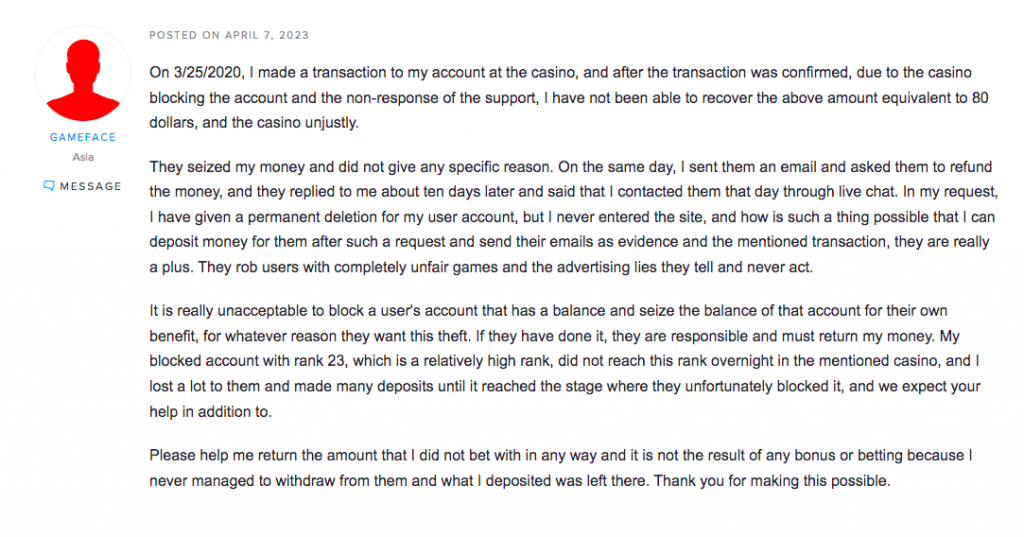
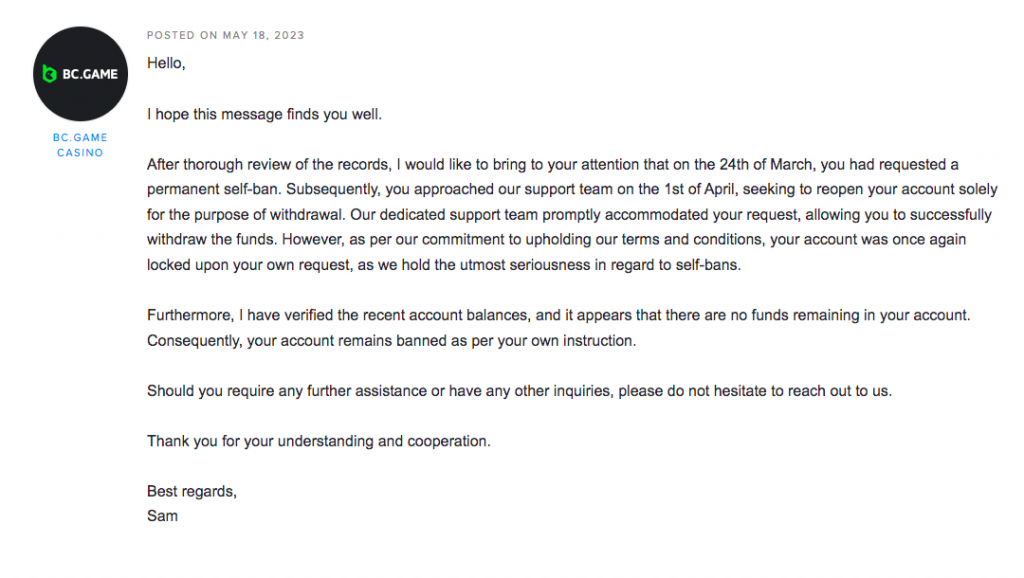
Here’s why that old story now comes with a serious warning. A casino that paid out cleanly two years ago can be a different operation today. Always re-check current complaints before you deposit, and don’t take an old “trustworthy” label at face value – including ours.
Metaspins: when a refusal is justified
Not every refusal is the casino being shady. In this Metaspins case, a player’s winnings were voided after the site flagged signs of multiple accounts and bonus abuse. The player complained publicly, but the casino’s reply laid out the terms breach clearly.
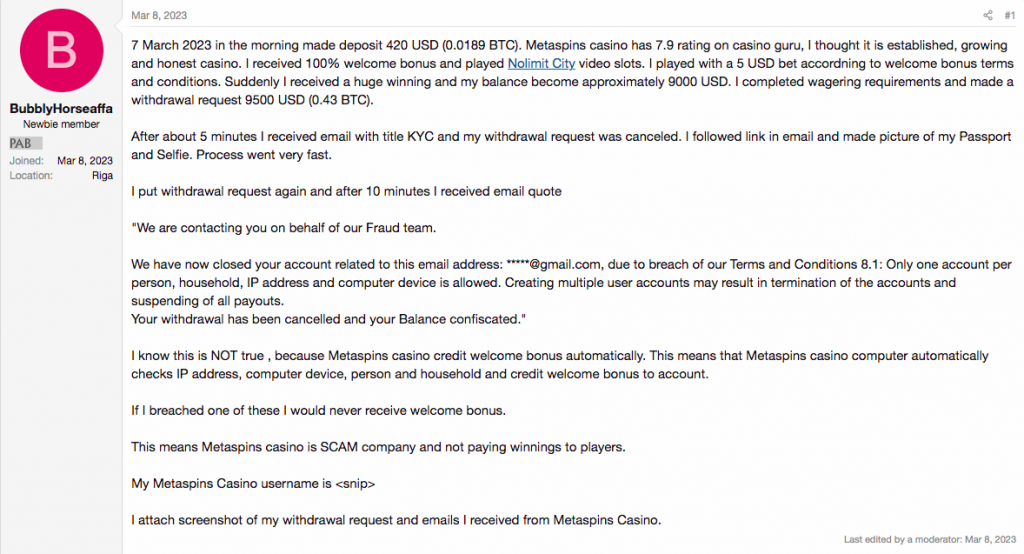
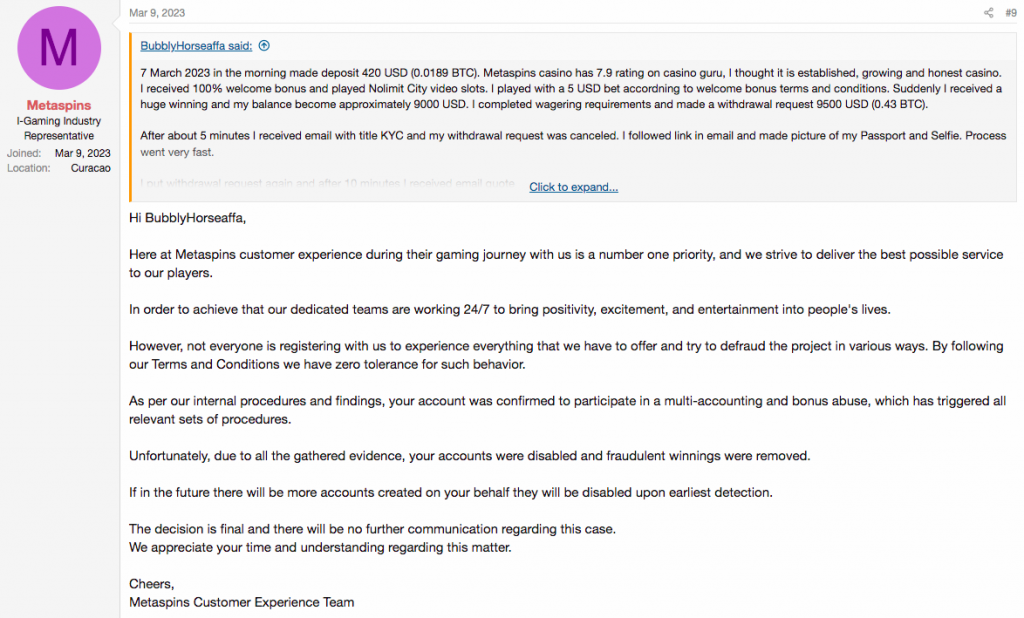
That is the kind of refusal you can’t really pin on the casino. The terms were broken, the casino documented it, and the winnings were forfeited. It’s a useful contrast: a fair void looks like a clear, evidenced terms breach. A scam looks like shifting excuses with no paper trail.
How to spot casinos that won’t pay out?
You don’t have to find out the hard way. The casinos that won’t pay tend to leave a trail, and two places show it plainly: Trustpilot and Reddit. On Trustpilot, the tell-tale pattern is “deposits go through fine, but the moment you win, they find a reason not to pay.”
You’ll also spot the “no KYC” bait – sites that advertise no verification, then spring strict checks only at withdrawal.
Reddit threads in gambling and crypto-casino subs are where people name specific operators and post screenshots of frozen balances and dead support tickets.
The patterns repeat across brands. Spinit had winnings confiscated over an alleged bonus terms breach, resolved only after a formal complaint. Roobet has drawn reports of large withdrawals stuck “under review” for ages. The names change; the playbook doesn’t. Here’s what to watch for:
- Rotating excuses: “verification in progress,” then “compliance review,” then “technical issue” – all for the same withdrawal
- Any withdrawal delayed past roughly 72 hours with reasons that keep shifting
- Support going quiet the second you ask about a withdrawal, after being chatty at deposit
- “No KYC” advertised up front, with strict verification triggered only when you cash out
- Bonus or T&C clauses invoked only after a big win, never mentioned before
- A pile of unresolved complaints on Trustpilot and Reddit
- No visible license information anywhere on the site
If you want a full checklist for vetting an operator before you deposit a cent, we put one together here: how to tell if a crypto casino is legit.
How to avoid payout refusal
Most of this comes down to a bit of homework before you play. Do these, and you’ll dodge the vast majority of payout problems:
- Pick a casino with a real license from a respected regulator, not a logo with no number behind it
- Complete KYC early, right after sign-up, so there’s nothing to “review” when you win
- Read the bonus terms in full: wagering, max bet, eligible games, and time limits
- One account per person, and only play from a country the casino actually allows
- Check current Trustpilot and Reddit reports before depositing – recent ones, not year-old reviews
- Keep your registration details and payment method consistent throughout
What to do If a casino won’t pay out
Say it’s already happened. Don’t panic, and don’t rage-quit your account. There’s a clear escalation path that recovers real money every year, and working it in order gives you the best shot.
- Exhaust the casino’s own complaint process first. Contact support in writing, ask for the exact reason and the specific term you allegedly breached, and request escalation to a complaints manager. Stay calm and factual.
- Put it in writing and build your file. If the casino stalls, send a formal written complaint that references the exact terms and includes your evidence. A clear, documented dispute is much harder to ignore than an angry live-chat message, and it sets up every step that follows.
- Escalate to an ADR body. If your casino is tied to an alternative dispute resolution provider like eCOGRA or IBAS, lodge a formal dispute there. Under Curaçao’s LOK law (in force since December 2024), licensees must offer mandatory independent ADR as of September 2025.
- Go to the regulator. For a UKGC-licensed site, the operator must give a final response within 8 weeks, after which you can escalate. The Malta Gaming Authority (MGA) runs a Player Support Unit with an online “Lodge a Complaint” form. For Curaçao, the Curaçao Gaming Authority (CGA) routes you to a certified ADR provider rather than recovering your funds directly. You can find the UK regulator at the UKGC.
One honest caveat: regulators enforce rules and license conditions, but they generally don’t act as a personal recovery service for individual balances. That’s exactly why the free complaint platforms and ADR bodies are your most practical tools. And whatever you do, build your case as you go.
Take screenshots of everything: your winning balance, the withdrawal request, every support message, and the relevant terms as they read at the time. A clear paper trail is the single most powerful thing you can bring to a dispute.
The bottom line
Crypto casinos refuse payouts for a mix of fair reasons and shady ones.
The fair ones – failed KYC, multiple accounts, restricted locations, unmet wagering – are almost entirely avoidable if you do a little homework before you deposit.
The shady ones come from operators who never planned to pay, and they wave the same red flags every time: shifting excuses, withdrawal-only verification, silence from support, and a wall of unresolved complaints.
Vet the license, read the terms, verify early, and check recent complaints. If a casino still won’t pay what you’re owed, you’re not powerless – work the escalation ladder, keep your screenshots, and lean on the free complaint services that recover millions for people every year. Win smart, and you keep what you win.